Blog
WhatsApp Chatbot Automation for Healthcare: The Complete 2026 Guide
December 20, 2025
10 min read
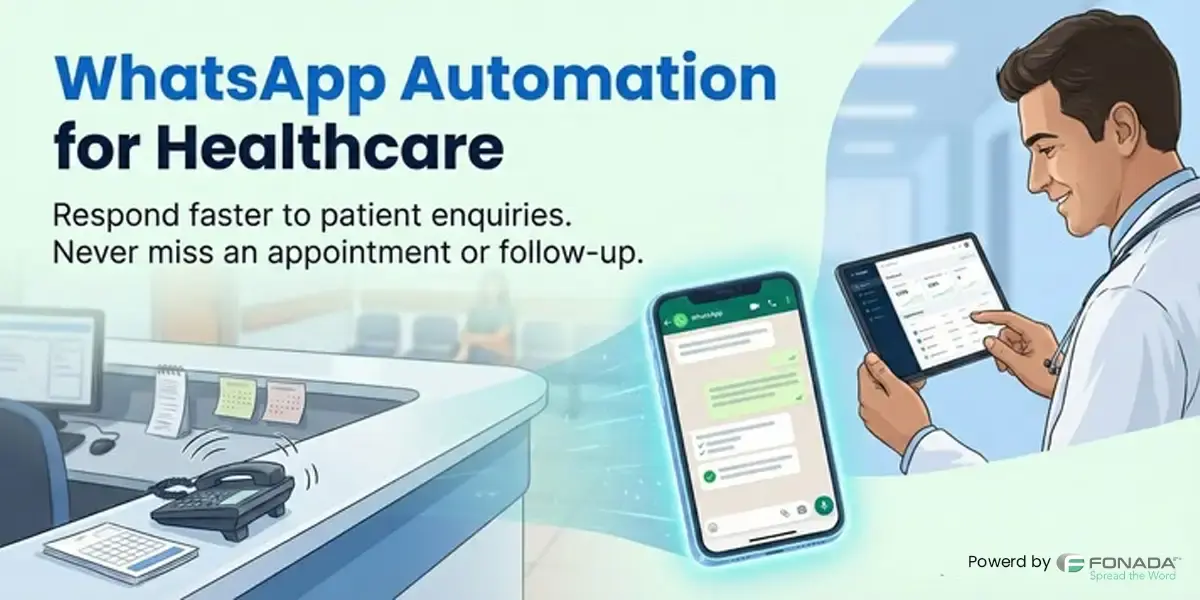
Imagine the typical Monday morning in a mid-sized multi-specialty hospital.
The waiting room is humming with restless energy. A young mother is trying to soothe a crying infant while glancing anxiously at the clock. At the reception desk, the phone is ringing relentlessly. It is a harsh and unending trill that competes with the noise of patients asking questions. The receptionist is overworked and multitasking. They are trying to verify insurance details for one patient, answer a call about a rescheduling request, and direct a confused senior citizen to the radiology department.
Somewhere in that chaos, a call goes unanswered. That missed call was a new patient trying to book a high-value surgery consultation. Frustrated by the busy tone, they hang up and call the competitor down the street.
This is exactly the gap a Chatbot for Healthcare is designed to solve.
This scenario is not an exaggeration. It is the daily reality for thousands of healthcare providers globally. Even today, many hospitals operate without a WhatsApp Chatbot for Healthcare, relying entirely on manual calls and front-desk staff to manage patient communication.
The healthcare industry faces a unique paradox where medical science has advanced at lightspeed, but patient communication in the WhatsApp Chatbot in Healthcare Space is still vastly underutilized. Hospitals continue to depend on outdated systems that simply cannot scale with patient expectations.
We are treating modern patients with archaic administrative tools. Patients who can order groceries in 10 minutes or book a cab in 30 seconds are forced to wait on hold for 20 minutes just to ask if the doctor is in today. This friction creates a gap. It separates patients from care and hospitals from efficiency—exactly why a WhatsApp chatbot for hospital communication is no longer optional, but essential.
Enter WhatsApp chatbot automation for healthcare.
This guide is not just about installing a piece of software. It is about a fundamental shift in how hospitals, clinics, and diagnostic centers interact with the people they serve. It is about taking the most popular messaging app in the world and turning it into a 24/7 digital front desk. In this post, we will explore the mechanics, the strategy, and the immense potential of WhatsApp automation for hospitals and clinics. We will dismantle the myths and explore the healthcare chatbot benefits while providing a roadmap for implementing systems that save time and lives.
The Anatomy of a Communication Breakdown
To understand why we need WhatsApp automation for healthcare, we first need to dissect the problem. Why is the current model failing?
1. The "9-to-5" Limitation vs. The "24/7" Need
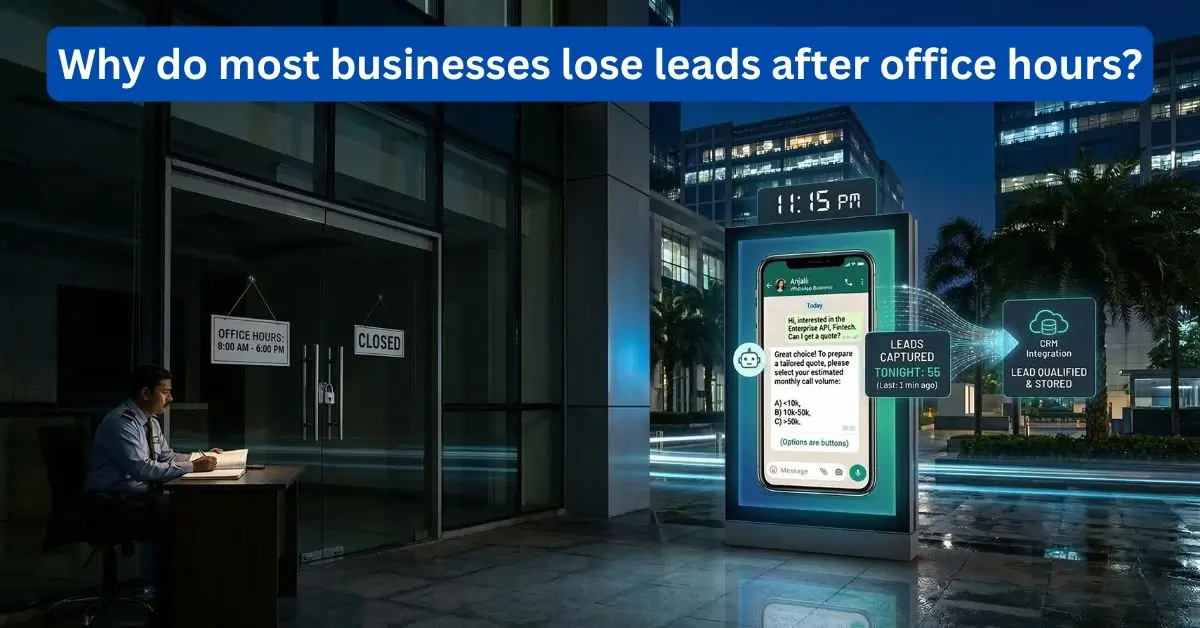
Sickness does not respect office hours. A fever often spikes at 2:00 AM. Anxiety about a surgery happens on a Sunday afternoon. When a patient has a query outside of reception hours, they are met with a voicemail or silence. This silence breeds anxiety. Anxiety leads to poor patient satisfaction and a breakdown in trust.
2. The Bottleneck of Voice Calls
Voice calls are synchronous. They require two people to be available at the exact same second. If your receptionist is talking to Patient A, then Patient B gets a busy signal. A human can only handle one conversation at a time. This scalability issue is the primary driver of patient churn in busy clinics.
3. The Fragmentation of Data
Patients are bombarded with paper slips, SMS messages from random shortcodes, and emails that go to spam. They lose their prescription. They forget their appointment time. They misplace their lab report. This fragmentation leads to missed appointments and poor medication reminders & treatment adherence.
The Solution: Meeting Patients Where They Live
WhatsApp Business API for healthcare solves these problems by moving communication to an asynchronous and centralized platform. It allows a hospital to handle 1,000 queries simultaneously around the clock without hiring a single extra staff member. This shift is similar to the efficiency gains seen in other sectors. For example, similar strategies are used in WhatsApp automation for interior designers in India to manage high-touch client interactions.
What Are WhatsApp Chatbots for Healthcare? (Beyond the Hype)
When we talk about healthcare chatbots, we are often met with skepticism. Doctors often worry that a robot cannot handle the empathy required for patient care.
This fear stems from a misunderstanding of what modern AI chatbots in healthcare actually do. We need to distinguish between the basic tools of the past and the intelligent assistants of today.
The Two Types of Healthcare Bots
1. Rule-Based Chatbots (The Digital Triage Nurse)
These are structured decision-tree bots. They work like a flowchart.
-
Bot: "Press 1 for Appointments, 2 for Reports."
-
Patient: "1"
-
Bot: "Choose Department: A) Cardio, B) Ortho."
This is excellent for healthcare workflows automation where precision is required. You do not want an AI guessing an appointment time. You want strict rules. If you want to build something like this yourself, you can read our guide on how to make a WhatsApp bot to understand the basics.
2. AI-Powered Healthcare Chatbots (The Empathetic Assistant)
These utilize Natural Language Processing (NLP). They understand intent.
-
Patient: "I have a sharp pain in my lower back and I can't move."
-
AI Bot: "I understand you are in pain. Based on your description, this sounds like an orthopedic emergency. Dr. Sharma is available. Should I connect you to the emergency line?"
These bots learn from interactions and can handle vague queries that would stump a rule-based bot. To dive deeper into the technology, check out our resource on the WhatsApp AI chatbot.
The Role of WhatsApp Business API
To deploy these bots at scale, you cannot use the standard WhatsApp app on a phone. You need the WhatsApp Business API. This is the enterprise-grade gateway that allows for verification and integration. It is the same technology stack used for WhatsApp automation in real estate lead generation, where instant response times are critical for conversion.
Seven Pillars of Whatsapp Automation: Use Cases for Hospitals & Clinics
Let us dive deep into the practical applications. How does WhatsApp automation for clinic and hospital workflows actually look in practice?
1. Appointment Scheduling Automation for Healthcare
This is the most critical application of healthcare automation. The friction of booking is the number one reason for lost patients.
The Workflow:
-
Entry: Patient clicks a "Book Now" link on Instagram or Google Maps that opens WhatsApp.
-
Selection: The bot presents a list of doctors or specialties.
-
Availability: The bot pulls real-time data from your HMS to show available slots.
-
Confirmation: The patient selects a slot. The bot instantly books it in the system and sends a confirmation PDF.
-
Calendar Sync: The appointment is added to the doctor's calendar and the patient's phone calendar.
The Impact:
We have seen clinics reduce their reception call volume by 40% simply by automating this single process.
2. The "No-Show" Killer: Intelligent Reminders
Missed appointments cost the global healthcare industry billions annually. A simple SMS reminder is easily ignored. WhatsApp allows for interactive reminders.
The Workflow:
-
24 Hours Before: "Hi Sarah, you have an appointment with Dr. Singh tomorrow at 10 AM. Please confirm you are coming."
-
Buttons: [Yes, I'll be there] [Reschedule] [Cancel]
If Sarah clicks [Reschedule], the bot automatically opens the calendar again. If she clicks [Yes], the slot is locked.
3. Patient Intake and Registration
The clipboard is the enemy of efficiency. Patients hate standing at the desk filling out forms while they are sick.
The Workflow:
Before the patient even arrives, the WhatsApp healthcare chatbot sends a "Pre-Arrival Registration" link. The patient fills in their name, age, symptoms, and insurance details on their phone. By the time they walk in, their file is already created. This is true hospital automation.
4. Lab Reports & Diagnostic Delivery
The old way involved patients traveling back to the hospital just to pick up a printout. With WhatsApp Healthcare Automation, the moment the pathologist signs off on a report in the lab software, a trigger is sent. The PDF is securely delivered to the patient’s WhatsApp. For sensitive results, the bot sends a secure link requiring a password rather than the file itself.
5. Medication Reminders & Treatment Adherence
For chronic conditions, the treatment happens outside the doctor's office. Patient engagement automation shines here.
-
Scenario: A TB patient needs to take medication daily for 6 months.
-
The Bot: Sends a daily message at 8:00 AM: "Good morning! Time for your medication. Please reply with a thumbs up when taken."
If the patient misses 3 days in a row, the bot alerts a human counselor to call the patient. This saves lives. This level of interaction is a prime example of effective healthcare patient engagement with SMS and IVR.
6. Post-Discharge Engagement (The "Nurture" Phase)
The most dangerous time for a patient is often the 48 hours after discharge. They are confused about diet, wounds, and meds.
AI chatbots in healthcare can run a "Post-Op Sequence":
-
Day 1: "How is your pain level on a scale of 1-10?"
-
Day 2: "Here is a video on how to change your dressing."
-
Day 3: "Reminder: You have a follow-up visit on Friday."
7. Emergency Triage & Ambulance Booking
While bots cannot handle medical emergencies, they can facilitate logistics. A bot can allow a user to share their "Live Location" on WhatsApp. This is instantly relayed to the nearest ambulance driver to shave precious minutes off response times.
The Psychology of Patient Engagement
Why do patients prefer WhatsApp healthcare chatbots? It comes down to control and comfort.
Healthcare is intimidating. Walking into a hospital feels like entering a fortress. WhatsApp feels like home. It is where you chat with your mom or your cricket group. By entering this space, the hospital feels less like an institution and more like a partner. This helps in building stronger brand communication by making the hospital feel accessible and human.
Reducing "White Coat Hypertension"
Many patients are afraid to ask "stupid questions" to a doctor. They fear wasting the doctor's time. They have no such fear with a bot. They can ask simple questions repeatedly, and the bot will answer patiently every time. This accessibility improves health literacy and outcomes.
AI vs. The Human Touch – Striking the Balance
A common criticism of hospital automation is that it removes the human element. The counter-argument is that automation protects the human element.
When a nurse spends 4 hours a day answering the phone to say "We are open until 8 PM," that is 4 hours she is not spending holding a patient's hand or checking a drip.
WhatsApp automation for healthcare removes the robotic tasks from humans. It filters the noise.
-
The bot handles the 80% of repetitive and mundane queries.
-
The humans handle the 20% of complex and emotional interactions.
The Handoff Protocol:
Every good chatbot must have an "Escape Hatch." If a patient types "I am scared" or "I am bleeding," the bot must instantly detect the sentiment using AI and trigger a "Human Agent Alert." The chat is then routed to a senior nurse's dashboard immediately.
Implementation Strategy: From Zero to Automation
How does a hospital go about setting this up? Here is a strategic roadmap.
Phase 1: The Foundation (Weeks 1-2)
-
Verification: Apply for WhatsApp API via a BSP like Fonada. Get the Green Tick to establish trust.
-
Basic Menu: Set up a simple rule-based bot. "Press 1 for Address, 2 for Doctors."
-
Marketing: Put a QR code at your reception desk that says "Scan to Chat with Us."
Phase 2: Integration (Weeks 3-6)
-
API Handshake: Connect the WhatsApp API to your HMIS/EMR software. This allows the bot to read doctor schedules and fetch patient IDs.
-
Template Approval: WhatsApp requires pre-approval for outbound messages. Draft these carefully to ensure they do not sound like spam. You can learn more about effective messaging in our bulk WhatsApp messages guide.
Phase 3: AI Training (Weeks 7-10)
-
Ingest FAQs: Feed your bot the last 6 months of patient queries. Train the NLP engine to recognize synonyms.
-
Medication Reminders: Launch the adherence programs for chronic patients. If you want to build custom flows, see our guide to create an AI chatbot.
Phase 4: Full Automation (Month 3+)
-
Payment Integration: Allow patients to pay consultation fees directly within WhatsApp via UPI or payment links.
-
Telemedicine: Send Zoom or Video links for remote consultations via WhatsApp.
Fonada: The Difference Maker in Healthcare Automation
In a crowded market of automation tools, why should healthcare providers choose Fonada?
Fonada is not just a software provider. We are a communication infrastructure specialist built for the complexities of the Indian market.
How Fonada is Different
-
Unified Communication Stack: Unlike generic bot builders, Fonada offers a complete suite. We integrate AI call center voice bots with WhatsApp. If a patient calls and you miss it, our Voice Bot answers and instantly sends a WhatsApp follow-up. This "Voice + Chat" synergy is unique to Fonada.
-
Startup & SME Focus: We understand that small clinics need enterprise power at affordable rates. Our solutions are similar to our IVR software for startups and SMEs which is designed for rapid deployment and ease of use.
-
Local Language Mastery: Healthcare in India is multilingual. Fonada’s bots are trained to handle Hindi, Tamil, Telugu, and Hinglish with high accuracy.
-
Deep Compliance: We ensure your data handling practices meet the necessary security standards which is non-negotiable in healthcare.
-
Future-Ready Tech: We are already integrating next-gen tech like Rich Communication Services (RCS) to ensure you are ready for the post-WhatsApp era of messaging.
Measuring Success: KPIs for WhatsApp Chatbot in Healthcare Space
How do you know if your WhatsApp automation for hospital strategy is working? You need to track the right metrics.
| Metric | Definition | Good Benchmark |
| Deflection Rate | Percentage of queries handled by bot without human help. | 70% to 80% |
| Response Time | How fast the patient gets the first reply. | < 2 Seconds |
| No-Show Rate | Percentage of patients who miss appointments. | < 5% |
| Booking Conversion | Percentage of chats that result in a booked appointment. | 15% to 20% |
| Patient Satisfaction (CSAT) | Rating given by patient after the chat. | 4.5/5 |
Real-World Scenarios (Hypothetical Case Studies)
The Busy Pediatric Clinic
Problem: Dr. Mehta’s clinic was drowning in calls from anxious parents asking about vaccination schedules.
Solution: They deployed a WhatsApp healthcare chatbot. Parents simply type the child's birth date, and the bot sends the full vaccination chart and sets auto-reminders for the next 5 years.
Result: Call volume dropped by 60% and vaccination compliance increased by 35%.
The Large Multi-Specialty Hospital
Problem: The hospital had a 25% No-Show rate for MRI scans which are expensive to keep idle.
Solution: They implemented a "Confirm Your Slot" WhatsApp flow 24 hours prior. If a patient cancelled, the bot automatically messaged the "Waitlisted" patients to fill the spot.
Result: MRI utilization went up to 95% which recovered significant lost revenue per month.
The Future of AI in Healthcare Communication
As we look toward 2026, AI-powered healthcare chatbots are evolving.
-
Voice AI: In countries like India typing is a barrier for many. Future bots will be voice-first. A patient will send a voice note in Hindi or Tamil describing their symptoms and the bot will reply in the same language.
-
Predictive Health: Bots will not just remind you to take pills. They will integrate with smartwatches. If your Apple Watch detects a high heart rate the WhatsApp bot might ping you to ask if you want to speak to a doctor.
-
Generative AI (LLMs): Instead of pre-written answers bots will generate custom dietary plans or exercise routines based on the patient's specific medical history.
Conclusion: The Digital Bedside Manner
The adoption of technology in healthcare is often viewed as cold or distant. But WhatsApp automation for healthcare proves the opposite.
By automating the mundane we liberate the humane.
When a hospital adopts hospital automation they are essentially saying to their patients that they value their time. They respect their anxiety. And they want to be available for them always.
For the clinic owner it means operational sanity and better revenue. For the doctor it means seeing patients who are pre-screened and prepped. But for the patient—the most important stakeholder—it means care is no longer a burden. It is a conversation.
The waiting room of the future is not a physical room with old magazines and coughing patients. It is a digital thread that is secure and instant sitting right inside the green icon on their phone.
If you are ready to transform your patient experience the technology is ready for you. The question is no longer if you should use AI chatbots in healthcare but how fast you can implement them to stay ahead.
Ready to transform your healthcare communication?
Don't let another patient wait on hold.
Request a demo with Fonada today and build the future of patient care.
WhatsApp Chatbot Automation for Healthcare FAQs
No. Healthcare chatbots should always have a disclaimer stating they are automated assistants. They must provide an emergency number immediately if keywords like "heart attack" or "emergency" are detected.
It is easier than you think. Most modern platforms come with pre-built templates for hospital automation. You feed it your specific FAQs like fees and timings and the AI learns the rest over time.
Absolutely. WhatsApp automation for clinic setups are scalable. You can start with a simple plan for appointment booking and scale up as you grow.
Fonada provides a white-glove onboarding service. We help you get API verification, design your conversational flows, and integrate with your existing hospital software.
Yes. When using the official WhatsApp Business API for healthcare messages are end-to-end encrypted. However you must always follow your country's specific health data regulations regarding what specific data can be shared. Fonada ensures your setup is secure.
Share
.gif "Side Bar Gif")
Subscribe To Our Newsletter
Get updates and learn from the best

Mar 09, 2026
AI Telecallers: The Complete Guide to Automating Inbound Calls with AI Voice Agents
Missing a customer call is like closing the door on a paying client. F... Read More
Mar 06, 2026
The Role of AI Chatbots in Lead Qualification and Conversion
The digital world moves incredibly fast today. Capturing the attention of your website visitors is h... Read More
Feb 18, 2026
How AI is Transforming Collections & Payment Automation: The 2026 Guide
Let’s start with a hard truth that nobody likes to talk about at... Read MoreLatest Updates
From Fonada
Industry Insights, Trends, Innovations, Updates, and Case Studies from Industry Experts
View
Customer
Reviews
Discover why our customers love us - read their authentic and heartfelt reviews!
View
Case
Studies
Explore real-life scenarios, offering analysis, and solutions to practical challenges
View
Convert Leads Into Sales With Fonada
Trusted CPaaS Solution Provider