Blog
Prompt Engineering for AI Agents | Improve LLM Responses in Enterprise Workflows | Fonada
May 22, 2026
7 min read
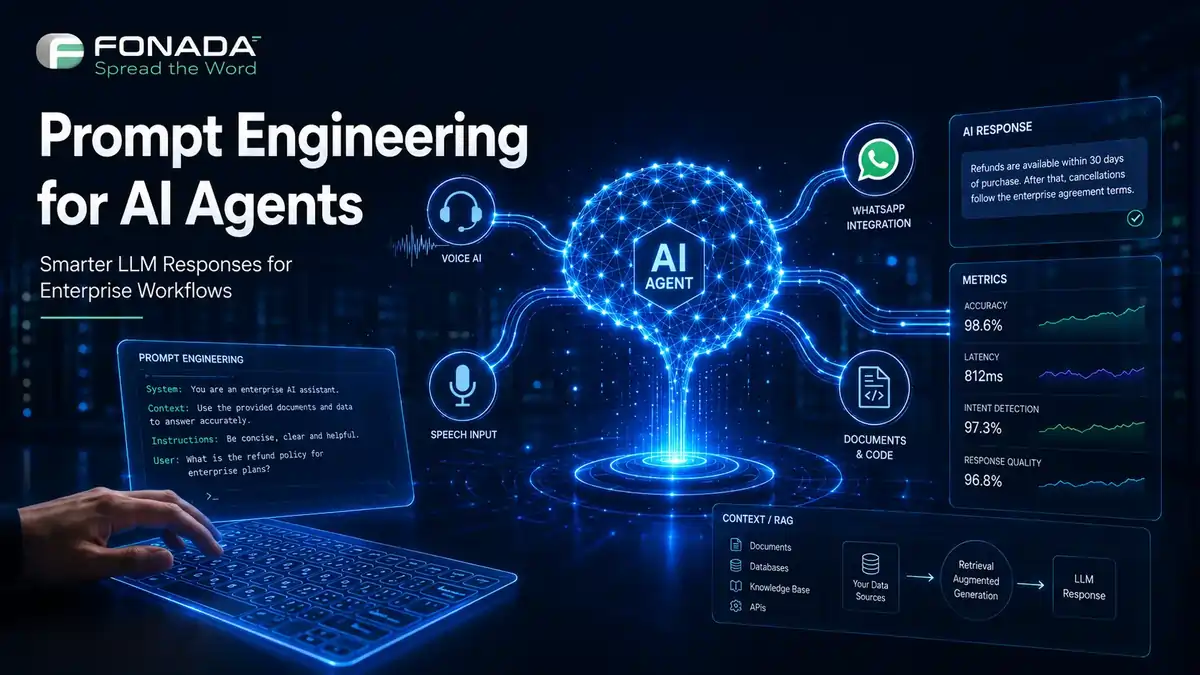
Prompt Engineering for AI Agents: How to Improve LLM Responses in Real-World Enterprise Workflows
If you have ever watched an AI agent confidently give the wrong answer, you already understand why prompt engineering for AI agents matters more than most people think.
AI systems are only as good as the instructions behind them. You can have the most powerful large language model running in your infrastructure and still end up with confused customers, missed leads, and broken workflows if the prompts directing that model are poorly designed. This is the silent problem that derails many enterprise AI deployments.
In this guide, we will walk through everything that actually matters when it comes to LLM prompt engineering for business use. We will cover real examples, common failures, and how companies in India are already using smarter prompt strategies to build AI agents that work reliably at scale. Whether you are running an AI call center, a WhatsApp AI chatbot, or a full enterprise conversational AI platform, the principles in this guide apply directly to you.
What Is Prompt Engineering in AI Agents?
Prompt engineering is the practice of designing, structuring, and refining the text instructions you give to a large language model so it produces the outputs you actually want. Think of it as writing a job description for your AI. If the job description is vague, the new hire is going to guess. And when AI agents guess, they often guess wrong.
In an AI agent workflow, a prompt is not just a one-line question. It is a full instruction set that tells the model who it is, what its purpose is, what it should say, what it should never say, what to do when it does not know an answer, and how to behave in different conversation scenarios.
There are three main layers to a well-structured AI agent prompt:
- System Prompt: The foundational instruction that sets the agent's identity, tone, and rules. This runs in the background and the end user does not see it.
- Context Injection: Dynamic data added to the prompt at runtime, like the customer's name, order status, or account details. This is often tied to Retrieval Augmented Generation (RAG).
- User Prompt: The live message from the end user that the model is actually responding to.
All three layers need to work together. If any one of them is broken, the agent's response quality drops.
Why Prompt Engineering Matters for Enterprise AI
Let's be straightforward about this. In a consumer setting, if a chatbot gives a slightly odd response, the user might just shrug and move on. In an enterprise setting, that same odd response could mean a compliance breach, a failed sale, an unhappy customer, or a legal issue.
Enterprise AI agents handle high volumes of real conversations. A single bad prompt configuration does not cause one problem. It causes that same problem thousands of times a day.
Here is what bad prompt engineering actually looks like in practice:
- An AI customer support agent tells a user their refund will arrive in three days when it actually takes ten. This happens because the prompt did not include accurate policy data and the model hallucinated a number.
- A voice AI agent in a bank verification workflow confirms an account balance that belongs to a different customer because the context injection step was skipped.
- A WhatsApp AI chatbot for a retail brand responds in English to a customer who wrote in Hindi, because the prompt had no multilingual handling instructions.
These are not hypothetical. They happen constantly in deployments that skip proper prompt design.
Fonada works with enterprise teams across India to build conversational AI systems that are designed to avoid exactly these failure points. From AI voice bots to WhatsApp automation for ecommerce, every reliable deployment starts with thoughtful prompt engineering.
Types of Prompts Used in AI Workflows
Not all prompts are the same. Different situations call for different prompt structures. Here are the main types used in production enterprise AI workflows:
| Prompt Type | What It Does | Best Used For |
|---|---|---|
| System Prompt | Sets agent identity, tone, rules, and scope | All enterprise AI agents |
| Few-Shot Prompt | Provides example inputs and outputs so the model learns the pattern | Customer support, classification, intent detection |
| Chain-of-Thought Prompt | Instructs the model to reason step by step before answering | Complex queries, multi-step decisions |
| RAG Prompt | Injects retrieved documents or data into the context before answering | Policy lookups, product queries, knowledge bases |
| Structured Output Prompt | Instructs the model to return data in a specific format (JSON, table, list) | CRM updates, form filling, backend integrations |
| Fallback Prompt | Defines what the agent should say when it cannot answer | All production agents |
Each of these has its place. In most enterprise workflows, you will use a combination of several. For example, a good AI chatbot for banking typically uses a system prompt, RAG for policy data, structured output for data capture, and a fallback script for anything outside scope.
Prompt Engineering Best Practices for AI Voice Agents
Voice AI is a special case in prompt engineering. When someone is speaking to an AI over the phone or through a voice interface, the rules change significantly compared to text-based chatbots.
Here are the practices that matter most for AI voice agent prompts:
Keep sentences short and natural. Voice output needs to sound like a real person talking, not reading a document. Instruct your model to keep responses under two sentences when possible and to avoid complex clause structures.
Account for speech-to-text noise. Callers sometimes speak with accents, background noise, or unclear pronunciation. Your prompt should tell the agent to ask for confirmation rather than assume it understood correctly.
Build in interruption handling. Real conversations include interruptions. Your prompt should define how the agent recovers when a user cuts it off mid-sentence.
Define the greeting and closing script. In voice workflows, the first three seconds decide whether the customer stays on the call. Your prompt should specify exact language for introductions and sign-offs.
Set language fallback rules. For Indian enterprise deployments, regional language handling is critical. Instruct the agent to detect when a user switches language and respond accordingly, or to escalate to a human agent.
Fonada's voice AI platform has handled over 25 lakh calls in a single day. That kind of scale is only possible when prompt architecture is built to handle every edge case before it becomes a live problem.
Common Prompt Engineering Mistakes
Even experienced teams make these mistakes. Knowing them upfront saves a lot of debugging time.
1. Prompts that are too vague. A prompt like "You are a helpful customer service agent" tells the model almost nothing. What kind of company? What products? What tone? What can it not discuss? Vague prompts produce vague, inconsistent responses.
2. No fallback instruction. Every AI agent will eventually get a question it cannot answer. If your prompt does not tell the agent what to do in that case, the model will try to answer anyway, and it will likely make something up.
3. Overloading a single prompt. Some teams try to make one prompt do everything: handle billing queries, upsell products, collect feedback, and escalate complaints. This leads to confused, inconsistent behavior. Use prompt chaining to break complex workflows into steps.
4. Skipping negative instructions. It is not enough to tell the model what to do. You must also tell it what NOT to do. "Never discuss competitor products. Never make promises about delivery timelines. Never confirm information you are not certain about." These negative guardrails prevent a class of failures that positive instructions alone cannot stop.
5. Testing only in ideal conditions. Most teams test their AI agent with perfect, clean inputs. But real users write with typos, incomplete sentences, mixed languages, and off-topic requests. Test your prompts with messy, realistic inputs before going live.
How Enterprises Use Prompt Engineering in Customer Support
Customer support is the most common enterprise use case for AI agents in India today. Here are three real-world use cases from the Indian market that show how prompt engineering drives results:
Use Case 1: Ecommerce Return and Refund Bot (Retail Sector, India)
A mid-sized Indian ecommerce platform was managing over 10,000 support queries daily around returns, refunds, and delivery updates. Their human agents were overwhelmed during sale seasons. They deployed a WhatsApp AI chatbot powered by Fonada.
The prompt was structured with three layers: a system prompt that defined the agent as a polite, Hindi-English bilingual support assistant, a RAG layer that pulled real-time order data from their backend, and a structured output layer that logged every resolved query into their CRM automatically.
Result: 78 percent of queries were resolved without human handoff. Customer satisfaction scores improved because responses were consistent and fast. You can read more about how ecommerce brands handle 10,000 queries without extra staff.
Use Case 2: Real Estate Lead Qualification Bot (Property Sector, India)
A real estate developer in Pune used a voice AI agent to qualify inbound leads after business hours. The challenge was that callers spoke in Marathi, Hindi, and English, sometimes switching mid-conversation.
The prompt was built with explicit language detection logic, qualification question sequences (budget, location preference, timeline), and a structured handoff prompt that summarized the lead details for the human sales team to pick up the next morning.
Result: The developer stopped losing leads after hours and saw a 40 percent increase in qualified leads entering their sales pipeline. More details are covered in this guide on how to stop losing leads after business hours, and in Fonada's work with AI voice bots for real estate lead generation.
Use Case 3: Healthcare Appointment and Reminder Bot (Healthcare Sector, India)
A hospital chain in South India needed to reduce no-show rates for outpatient appointments. They deployed an AI voice agent that called patients the day before their appointment to confirm attendance, reschedule if needed, and provide preparation instructions.
The prompt for this agent had strict guardrails: no medical advice, no diagnosis, no discussion of medication. Its sole job was appointment management. This focused scope made the prompt tight, reliable, and easy to maintain.
Result: No-show rates dropped by 35 percent within the first month. The team also integrated this with SMS and IVR workflows for patients who did not answer the voice call.
Reducing Hallucinations in AI Agents
Hallucination, where an AI model confidently states something that is simply not true, is the most damaging failure mode in enterprise AI. When a customer support agent hallucinates a discount that does not exist, or a voice bot confirms an appointment that was never booked, the consequences are real.
Here are the most effective prompt engineering techniques for reducing hallucinations:
Ground the model in your data. Use RAG to pull verified information before the model generates a response. The prompt should explicitly say "Answer only based on the information provided below. Do not use outside knowledge."
Use explicit uncertainty instructions. Tell the model: "If you are not certain of the answer, say 'I do not have that information right now. Let me connect you to a specialist.'" This is a simple instruction that prevents a large category of hallucinations.
Limit the model's scope. The more focused a prompt is, the less likely the model is to wander into territory where it might make things up. A prompt that covers one job well is safer than a prompt that tries to cover everything.
Validate structured outputs. When the model needs to produce data in a specific format (like a JSON object with customer details), include a validation step in your workflow to check that the output matches the expected schema before it is used downstream.
Fonada's enterprise AI platform includes built-in guardrail layers that work alongside prompt engineering to catch and block hallucinated responses before they reach the customer. This is one reason Fonada's AI customer service platform is trusted by enterprises that cannot afford unreliable AI responses.
Prompt Engineering for WhatsApp and Voice AI Automation
Two channels dominate enterprise AI communication in India: WhatsApp and voice calls. Both require channel-specific prompt design.
WhatsApp AI Prompts need to handle:
- Short, informal message styles
- Emoji and sticker inputs
- Media attachments (images of bills, invoices, product photos)
- Fast back-and-forth conversation flow
- Opt-in and opt-out compliance language
A WhatsApp AI chatbot for banking needs prompts that are especially careful about data privacy, confirmation steps for sensitive actions, and clear escalation paths. Similarly, a WhatsApp bot for the automobile industry benefits from prompts that guide users through test drive booking, service scheduling, and EMI queries in a structured, friendly way.
Voice AI Prompts need to handle:
- Background noise and call quality variation
- Caller impatience and interruptions
- Telephone-specific phrasing (callers say "yes" and "no" more than they type those words)
- Latency awareness (the prompt should produce shorter outputs to reduce wait time)
- Regional language and dialect accommodation
Fonada's auto dial software and call center IVR system are built to work with these prompt structures out of the box, making it easier for enterprises to deploy without building everything from scratch.
For teams exploring WhatsApp automation for lead generation, Fonada also has published resources on WhatsApp automation for real estate lead generation and a complete guide to sending bulk WhatsApp messages in 2026.
Future of Prompt Engineering in Enterprise AI
Prompt engineering is not going away. Even as models become smarter and more capable, the quality of the instructions you give them will continue to determine whether they work for your business or against it.
A few trends that are shaping how enterprise teams approach AI prompt optimization going forward:
Prompt versioning and testing pipelines. Teams are starting to treat prompts like code. They version them, test changes in staging before production, and measure performance metrics like resolution rate and escalation rate to decide which prompt version works better.
Multimodal prompting. As AI agents gain the ability to process images, documents, and audio alongside text, prompts will need to handle instructions across these modalities. A WhatsApp bot that can read an uploaded bill and process it automatically is already being tested in Indian BFSI deployments.
AI agent orchestration. More enterprises are building multi-agent systems where specialized AI agents hand off tasks to each other. Prompt engineering for these systems includes designing the handoff instructions between agents, not just the individual agent prompts.
Agentic reasoning and planning. Newer models can reason across multiple steps before responding. Prompts for these models include planning constraints, tool use permissions, and rollback instructions for when an action should not proceed.
The businesses that invest in understanding and improving their prompt engineering today will be the ones whose AI agents remain reliable and trusted as these technologies continue to develop. Platforms like Fonada are building the infrastructure that makes enterprise-grade prompt deployment practical and scalable, from virtual number management to click-to-call integrations and SMS solutions.
Ready to Deploy AI Agents That Actually Work?
If your business is ready to move beyond basic chatbots and into enterprise-ready AI workflows, the starting point is better prompt design. Whether you want to automate customer conversations on WhatsApp, deploy multilingual voice AI for outbound calling, or build scalable conversational AI for customer support, the architecture behind your prompts will determine whether your AI earns trust or loses it.
Fonada helps enterprises design, deploy, and optimize AI agents with production-tested prompting frameworks, multilingual voice AI, and proven results across Indian industries.
Request a demo with Fonada to see how enterprise AI voice and chat automation looks when it is built the right way.
Explore more solutions on the Fonada website here: 👉 Fonada
Get in touch with us:
👉 Contact us: https://bit.ly/47OjrVH
👉 WhatsApp: https://wa.me/7479574795?text=
👉 Subscribe on LinkedIn: https://bit.ly/4pPuQL8
👉 Subscribe A DEMO: https://calendly.com/connect-fonada/30min
FAQs
Enterprise AI agents handle thousands of conversations daily. A poorly written prompt can lead to hallucinations, off-brand responses, compliance issues, or poor customer experience. Prompt engineering ensures the AI behaves reliably at scale across different use cases like customer support, voice automation, and WhatsApp chatbots.
A system prompt is the background instruction that defines the agent's role, tone, constraints, and knowledge scope. A user prompt is the live input that comes from the end user during a conversation. In enterprise deployments, the system prompt is the most critical layer of prompt engineering.
Yes. Fonada is an enterprise AI platform that provides voice AI agents, WhatsApp AI chatbots, and conversational AI solutions with production-tested prompting frameworks. Fonada's teams work with businesses to design, test, and deploy AI agents that deliver reliable responses across Indian languages and enterprise use cases.
Prompt chaining is the technique of breaking a complex task into smaller steps, where the output of one prompt becomes the input of the next. It helps AI agents handle multi-step workflows like loan processing, appointment booking, or customer verification without overloading a single prompt.
Absolutely. Voice AI agents have unique needs. Prompts must account for speech-to-text noise, interruptions, regional accents, and short verbal responses. Good prompt engineering for voice AI includes phonetic formatting guidance, short sentence instructions, and fallback scripts for unclear inputs.
Prompt engineering for AI agents is the process of carefully crafting the instructions, context, and constraints you give to a large language model so it produces accurate, relevant, and safe responses in real-world workflows. Good prompt engineering defines who the agent is, what it should do, what it should avoid, and how it should handle edge cases.
Share
.gif "Side Bar Gif")
Subscribe To Our Newsletter
Get updates and learn from the best
Sep 22, 2026
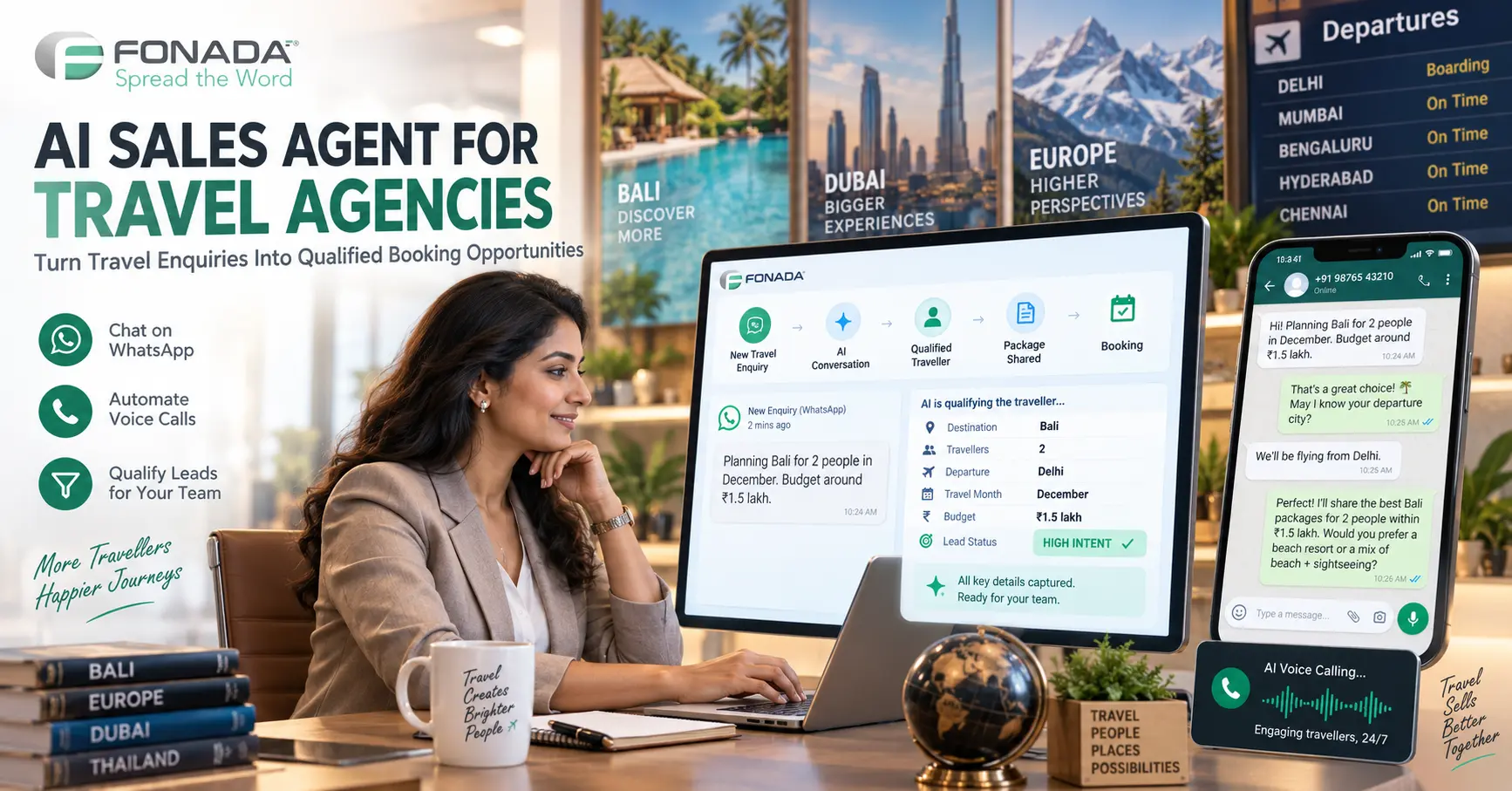
AI Sales Agent for Travel Agencies: Convert More Travel Leads
Travel enquiries rarely arrive at a convenient time. A family may ask for a Kerala package at 10:30... Read More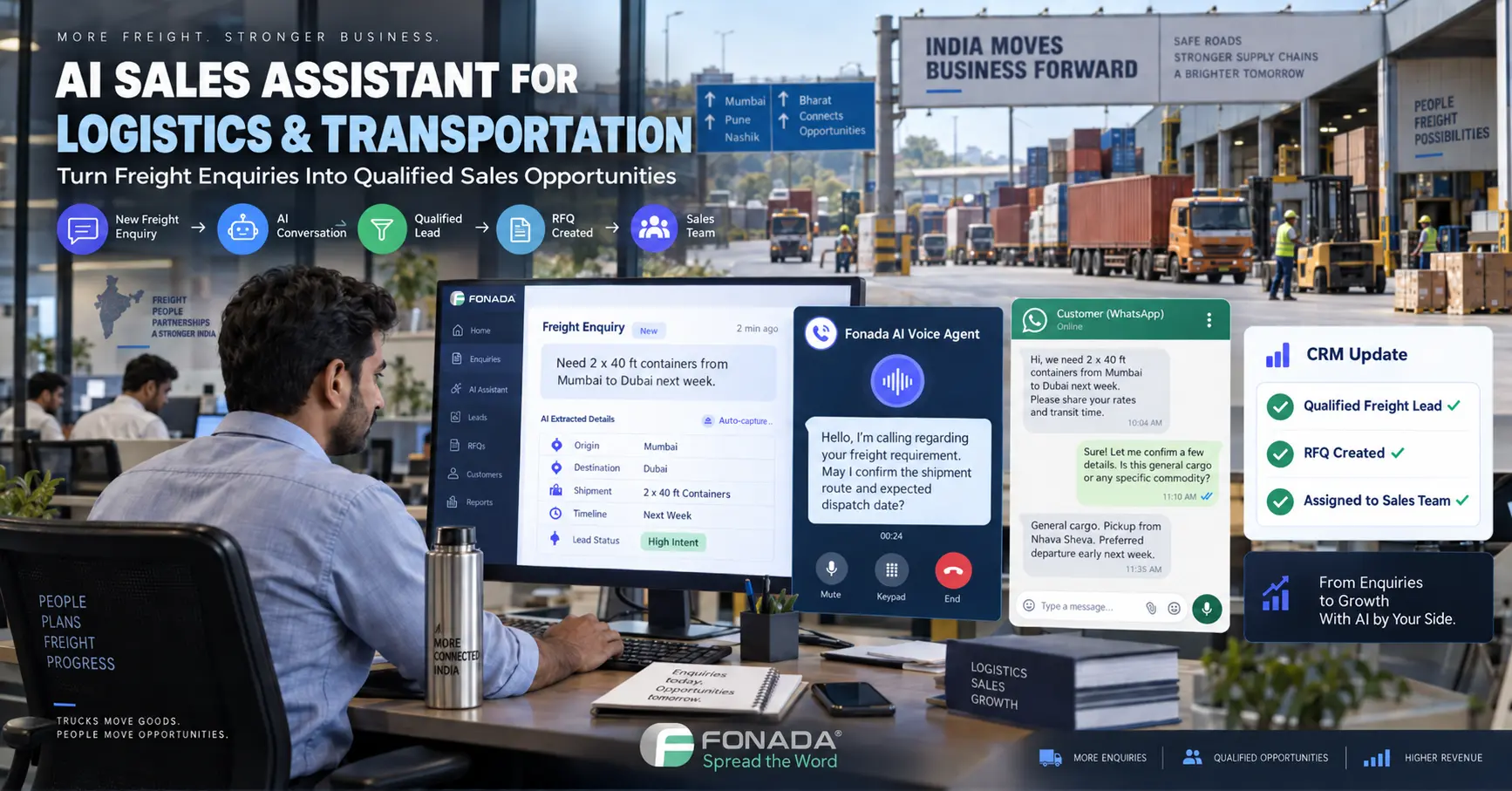
Sep 18, 2026
AI Sales Assistant for Logistics and Transportation
India’s logistics and transportation sector moves fast, but the sales process often does not.... Read More
Sep 02, 2026
AI Sales Assistant for Car Dealerships: How AI Can Turn More Enquiries into Test Drives and Sales
Buying a car in India rarely starts at the showroom today. A customer... Read MoreLatest Updates
From Fonada
Industry Insights, Trends, Innovations, Updates, and Case Studies from Industry Experts
View
Customer
Reviews
Discover why our customers love us - read their authentic and heartfelt reviews!
View
Case
Studies
Explore real-life scenarios, offering analysis, and solutions to practical challenges
View
Convert Leads Into Sales With Fonada
Trusted CPaaS Solution Provider