Blog
How Diagnostic Labs Can Automate Test Bookings and Home Collection Requests
October 9, 2026
8 min read
Introduction: Every Missed Call Could Mean a Lost Test Booking
A patient calls your diagnostic centre to book a blood test. Your receptionist is busy attending another customer. The phone rings several times, but nobody answers. The patient calls another laboratory and books the test.
For diagnostic centres, this is more than a missed conversation. It is a missed business opportunity.
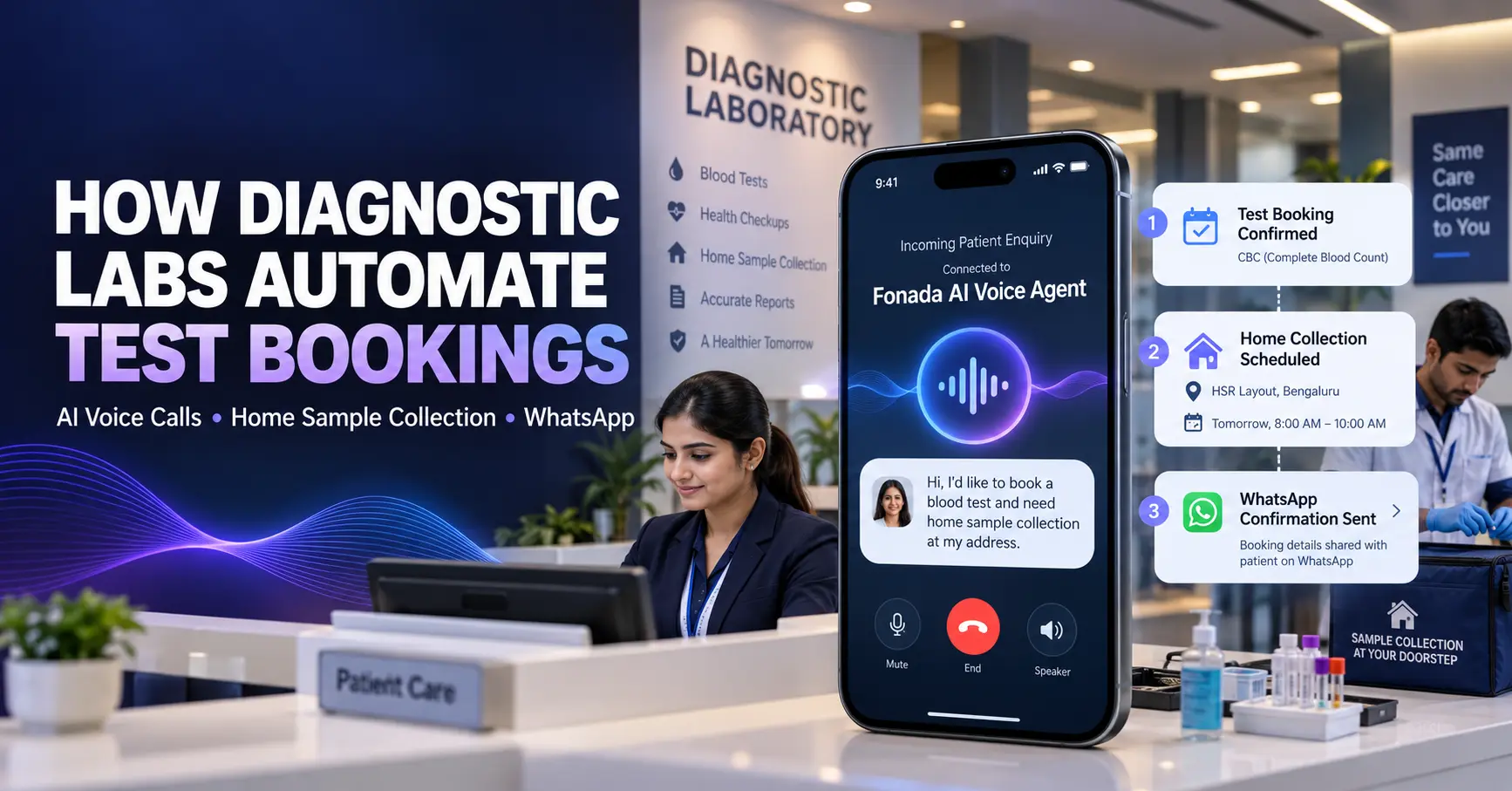
Diagnostic lab automation uses AI voice agents, WhatsApp communication and connected booking systems to handle patient enquiries, schedule tests, manage home sample collection requests and send appointment confirmations. It helps laboratories improve response times, reduce repetitive work and provide convenient booking experiences without depending entirely on manual calling.
For Indian pathology laboratories, the opportunity is especially relevant as patients increasingly expect convenient appointments, home collection services and timely updates.
What Is Diagnostic Lab Booking Automation?
Diagnostic lab booking automation is the process of using software and AI to manage laboratory appointments and related patient communication with less manual intervention.
Traditionally, patients contact a diagnostic centre, explain their requirements, ask about prices and wait while an employee checks available slots.
With an automated system, eligible requests can move through a structured booking workflow.
For example, a patient might say:
"I need a thyroid test tomorrow morning. Can someone collect the sample from my home?"
An AI voice agent can collect the test requirement, service location, preferred timing and contact details.
When connected to the relevant booking software, the system can check availability and submit the appointment request.
The result is a simpler experience for patients and less repetitive work for laboratory teams.
Why Do Diagnostic Labs Need Automation?
Diagnostic centres manage far more than sample testing.
Their teams coordinate enquiries, appointment bookings, home visits, technician availability, test preparation instructions and patient communication.
Handling everything manually becomes difficult as booking volumes increase.
Missed Patient Enquiries
Reception teams often handle incoming calls while assisting patients at the counter.
An unanswered call may represent someone comparing diagnostic centres or looking for an urgent appointment.
Automated missed call follow-up helps laboratories respond to these enquiries instead of leaving them unattended.
Repetitive Booking Questions
Patients regularly ask similar questions:
-
What is the price of a complete blood count test?
-
Is fasting required before my blood test?
-
Can I book a home sample collection?
-
Is collection available in my PIN code?
-
When will I receive confirmation?
An AI receptionist for diagnostic labs can answer approved administrative questions using verified laboratory information.
Questions involving clinical interpretation or uncertain test preparation should be transferred to qualified staff.
Home Collection Coordination
Home visits involve additional operational planning.
The laboratory must confirm whether the patient's location is serviceable, whether a phlebotomist is available and whether the requested time is suitable.
Without a proper booking system, overlapping appointments and incomplete addresses can create avoidable problems.
Limited Support After Working Hours
Many patients enquire about appointments during evenings or weekends.
A 24/7 AI appointment booking agent can capture requests outside normal reception hours, even when final confirmation requires staff approval.
How Can Diagnostic Labs Automate Test Bookings?
Diagnostic labs can automate test bookings by connecting patient communication channels with a reliable appointment management system.
A typical workflow includes six stages.
Step 1: Receive the enquiry
A patient calls the laboratory, submits a website enquiry or starts a WhatsApp conversation.
Step 2: Understand the requirement
The AI identifies the requested blood test, health checkup package or diagnostic service.
Step 3: Collect booking information
The system requests necessary details, such as patient name, contact number, preferred branch and appointment time.
Step 4: Check availability
Where supported, the AI checks available slots through the laboratory's booking software.
Step 5: Confirm the appointment
The booking is recorded only after the required availability and validation checks are completed.
Step 6: Send confirmation
The patient receives appointment details through an authorised communication channel.
This workflow can reduce the number of manual conversations required for routine bookings.
Can an AI Voice Agent Book Pathology Tests Automatically?
Yes, an AI voice agent for pathology labs can support automated test booking when connected to suitable scheduling software and verified service information.
For example:
Patient: "I want to book a lipid profile test."
AI Agent: "Would you prefer visiting our centre or booking home sample collection?"
Patient: "Home collection."
AI Agent: "Please share your PIN code so I can check whether collection is available."
Once availability is confirmed, the agent can continue the approved booking process.
The conversation feels natural because patients can explain their requirements using everyday language.
How Does an AI Receptionist Work in a Diagnostic Centre?
An AI receptionist receives calls, understands supported questions and follows configured workflows.
It may provide branch addresses, collection timings, service availability and booking assistance.
When a request requires human judgement, the system should transfer the conversation or arrange a callback.
How Does AI Automate Home Sample Collection Requests?
Home sample collection automation manages the communication and scheduling steps involved in arranging doorstep diagnostic services.
A successful system should consider more than the patient's preferred time.
It must account for location, service availability, collection capacity and laboratory instructions.
Step 1: Verify the Serviceable PIN Code
The AI collects the patient's PIN code and checks whether the laboratory provides home collection in that area.
Step 2: Identify the Requested Test
The system records the requested investigation or package.
Any uncertainty about the test name, prescription or suitability should be reviewed by trained personnel.
Step 3: Check Collection Slots
Connected home collection booking software can check available timings based on location and operational capacity.
Step 4: Assign the Request
Once confirmed, the appointment enters the laboratory's collection management workflow.
A phlebotomist may be assigned through the existing operations system.
Step 5: Share Appointment Information
The patient receives a confirmation containing the collection window, booking reference and applicable instructions.
Step 6: Handle Changes
If the patient requests rescheduling, the system can check alternative slots or transfer the request to staff.
This approach makes home collection request management more organised without compromising operational checks.
How Can Diagnostic Labs Use WhatsApp for Test Bookings?
WhatsApp automation for diagnostic labs provides another convenient communication channel for appointments and routine updates.
Patients can enquire about services, request booking assistance or receive authorised appointment notifications.
For example, after an approved booking, the laboratory could send:
"Your home sample collection is confirmed for tomorrow between 8 AM and 9 AM. Please contact our team if you need assistance."
Messages should contain only necessary information and follow applicable patient consent, privacy and messaging requirements.
When voice and WhatsApp workflows are connected, an enquiry initiated over a call can continue through messaging.
For further reading, explore Fonada's guide on how to build a WhatsApp bot.
What Are the Benefits of AI Voice Agents for Pathology Labs?
AI voice agents can improve laboratory operations when their workflows are properly configured and integrated.
|
Business Challenge |
AI Automation Opportunity |
|---|---|
|
Missed incoming calls |
Automated call answering and follow-up |
|
Repetitive enquiries |
Responses using approved lab information |
|
Manual test bookings |
Connected appointment scheduling |
|
Home collection coordination |
Structured request and slot management |
|
Booking cancellations |
Rescheduling assistance |
|
Appointment reminders |
Automated voice and WhatsApp notifications |
|
High reception workload |
More time for complex patient enquiries |
The actual benefits depend on call volumes, software integrations, workflow accuracy and patient adoption.
Laboratories should measure performance rather than assume that automation always reduces costs.
Real-World Scenarios for Indian Diagnostic Centres
The following examples illustrate possible use cases. They are not presented as actual Fonada customer results.
Scenario 1: Pathology Chain in Delhi NCR
Imagine a diagnostic chain receiving enquiries from patients across Delhi, Noida and Gurugram.
A patient requests home blood sample collection.
An AI calling agent collects the test name, preferred date and PIN code.
The booking system checks the serviceable area and available appointments before confirming the request.
This allows the organisation to manage enquiries across multiple locations through a consistent process.
Scenario 2: Independent Diagnostic Centre in Jaipur
A small laboratory receives regular calls about health checkup packages.
Its two receptionists also handle walk-in registrations and billing.
An AI receptionist answers common service enquiries and captures booking requests when employees are occupied.
The team can then concentrate on patients who require assistance at the centre.
Scenario 3: Diagnostic Laboratory in Bengaluru
A laboratory manages several home collection appointments every morning.
Some patients cancel shortly before their scheduled visit.
An automated calling workflow contacts patients in advance and records confirmation or rescheduling requests.
Operations staff can use this information to review collection schedules and reduce unnecessary coordination.
How Can Fonada Help Diagnostic Labs Automate Patient Communication?
Fonada offers AI voice and business communication solutions that diagnostic centres can evaluate for routine patient engagement.
Potential workflows include inbound enquiry handling, automated patient calls, appointment reminders, WhatsApp communication and booking assistance.
A laboratory can explore connecting these communication channels with existing CRM, booking or laboratory management systems, subject to confirmed integration capabilities.
For organisations comparing conventional telephony with conversational automation, Fonada's AI call centre and voice bot guide explains the broader technology.
Labs considering outbound calling can also review Fonada's guide to recovering enquiries after business hours.
Want to explore automated diagnostic test enquiries and home collection calls? Book a Fonada AI demo.
Can AI Integrate With Existing Lab Management Software?
Many laboratories already use a Laboratory Information Management System (LIMS), Laboratory Information System (LIS), CRM or appointment management platform.
Automation becomes more useful when these systems exchange information securely.
For example, an AI agent may need access to service availability, appointment slots and booking status.
Integration through suitable APIs can support these workflows, provided the existing software allows the required operations.
Before choosing any provider, laboratory managers should verify technical compatibility, access controls, error handling and maintenance responsibilities.
How Should Diagnostic Labs Protect Patient Information?
Patient trust is essential in healthcare communication.
AI automation should collect only the information required for an authorised task.
Diagnostic centres must also evaluate secure storage, staff permissions, message delivery and access to sensitive medical information.
India's Digital Personal Data Protection Act, 2023 and DPDP Rules, 2025 provide an important legal framework, with implementation obligations subject to their commencement schedules.
The Ayushman Bharat Digital Mission also emphasises privacy, security and consent-based handling of health records.
Laboratories should review applicable requirements with qualified advisers before processing patient information through new systems.
How Can a Small Diagnostic Lab Start With AI Automation?
Smaller laboratories do not need to automate everything immediately.
Start with one clearly defined problem, such as missed patient calls or appointment reminders.
Document the existing process and identify what information staff members use to complete each request.
Next, test an AI workflow with approved answers and clear human escalation options.
Monitor booking accuracy, unsuccessful calls, patient feedback and staff workload.
Expand only when the initial process works reliably.
This practical approach helps laboratories avoid unnecessary technical complexity.
Key Takeaways
-
Diagnostic lab automation can simplify patient enquiries and routine appointment management.
-
AI voice agents can support test booking and home collection requests.
-
Serviceable PIN codes and available collection slots must be verified.
-
WhatsApp can support appointment confirmations and authorised reminders.
-
Existing laboratory software integration is important for reliable automation.
-
Patient privacy and human escalation must remain central to implementation.
Conclusion: Make Every Diagnostic Booking Easier
Patients should not have to call repeatedly to book a blood test or arrange sample collection.
For diagnostic centres, improving this experience begins with better communication and more organised booking workflows.
AI automation can help laboratories answer routine enquiries, coordinate appointments and follow up consistently.
The goal is not to remove personal care. It is to help staff spend less time on repetitive coordination and more time supporting patients.
Fonada's communication solutions can be evaluated as part of this journey.
Ready to simplify test bookings and home collection enquiries? Request a Fonada demo.
FAQs
Yes. AI can collect location details, preferred timings and test requirements. Final scheduling requires confirmation of service availability and collection capacity.
Integration may be possible through supported APIs. Laboratories should verify compatibility with their existing LIMS, LIS, CRM or booking platforms.
Pricing depends on call volumes, channels, integrations, language requirements and the provider's commercial model. Laboratories should request a quotation based on their expected usage.
Small laboratories can begin with automated call answering, missed call follow-ups and appointment reminders before implementing more complex booking workflows.
Yes, multilingual AI voice systems can support Hindi when the selected platform provides appropriate language capabilities. Performance should be tested with real accents and common patient enquiries.
Automated reminders and confirmation requests can support better attendance planning. Results depend on patient responses, scheduling processes and implementation quality.
Yes. WhatsApp workflows can capture enquiries, send approved notifications and assist with booking coordination when appropriate integrations and permissions are available.
Yes. Properly configured AI agents can receive booking requests throughout the day and night. Confirmed appointments depend on connected scheduling systems and availability rules.
Share
.gif "Side Bar Gif")
Subscribe To Our Newsletter
Get updates and learn from the best
Oct 09, 2026
How Diagnostic Labs Can Automate Test Bookings and Home Collection Requests
Introduction: Every Missed Call Could Mean a Lost Test Booking A pa... Read More
Sep 28, 2026
WhatsApp Marketing Bidding for Fintech in India: Meta Max Price, Timing & Delivery Guide (2026)
Meta is moving WhatsApp marketing beyond a fixed-price messaging model... Read More
Sep 22, 2026
AI Sales Agent for Travel Agencies: Convert More Travel Leads
Travel enquiries rarely arrive at a convenient time. A family may ask for a Kerala package at 10:30... Read MoreLatest Updates
From Fonada
Industry Insights, Trends, Innovations, Updates, and Case Studies from Industry Experts
View
Customer
Reviews
Discover why our customers love us - read their authentic and heartfelt reviews!
View
Case
Studies
Explore real-life scenarios, offering analysis, and solutions to practical challenges
View
Convert Leads Into Sales With Fonada
Trusted CPaaS Solution Provider