Blog
How to Reduce Lead Leakage in Real Estate Sales Teams with Fonada
June 2, 2026
9 min read
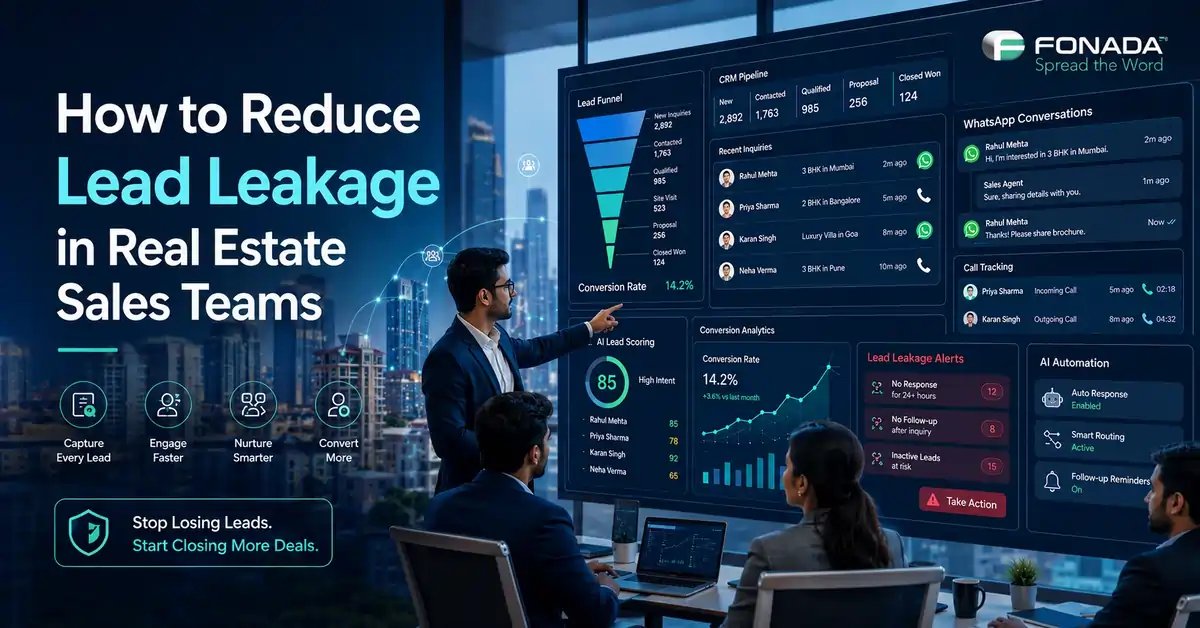
If you are running a real estate business in India, you already know how hard it is to generate quality leads. You run ads on Google Ads, Meta Ads, housing portals like MagicBricks, 99acres, Housing and NoBroker. You spend Thoushands of rupees every single month. And then what happens? Your sales team misses calls. Leads go unanswered for hours. Follow-ups are forgotten. Prospects move on to the next broker.
This is called lead leakage and it is one of the biggest silent killers of real estate businesses in India today.
The sad part? Most real estate companies do not even realise how many leads they are losing. They think the problem is with the marketing team or the ad spend. But the real problem is much closer to home. It is in the sales process, in the follow-up habits, and in the lack of a proper lead management system.
In this blog, we will break down everything you need to know about real estate lead leakage, what causes it, how to identify it in your own team, and most importantly, how to stop it using tools, processes, and automation. We will also talk about how platforms like Fonada are helping real estate companies across India fix this problem at scale.
What is Lead Leakage in Real Estate?
Lead leakage in real estate refers to the process by which potential buyers or investors who showed interest in your property get lost somewhere in your sales pipeline before they convert into actual customers.
Think of your sales pipeline as a bucket. You keep pouring water (leads) into it from the top. But if the bucket has holes (gaps in your process), the water just keeps draining out. You keep filling it up, but the level never really rises.
That is exactly what lead leakage feels like. You generate hundreds of leads every month, but only a handful actually end up booking a flat or plot. The rest just disappear somewhere between the first inquiry and the final closure.
In India, real estate lead conversion rates are typically between 1.7% and 4.1%. That means out of every 100 leads, 95 to 98 of them are not converting. A significant chunk of that is preventable leakage.
Common Causes of Lead Leakage in Real Estate
Understanding why leads leak is the first step to fixing the problem. Here are the most common reasons real estate companies in India lose leads:
1. Slow Lead Response Time
This is the number one cause of lead leakage. Studies show that if you do not respond to a lead within the first five to seven minutes of their inquiry, the chances of converting them drop by more than 73%. In real estate, where buyers are comparing three to eight projects at the same time, being slow means losing the race before it even starts.
Most sales teams in India respond to leads within hours, not minutes. By that time, the competitor has already called the prospect, pitched their project, and maybe even scheduled a site visit.
2. No Follow-Up System
A lead does not always convert on the first call. In real estate, the sales cycle can be anywhere from a few days to few weeks. During that time, you need to keep following up with the prospect regularly. Most sales teams do not have a structured follow-up process. They call once, maybe twice, and then forget about the lead.
3. Leads Getting Assigned to the Wrong Person
In many real estate companies, lead assignment is done manually or through a basic round-robin system. This means a lead looking for a 2.5BHK in South Delhi might get assigned to a salesperson who only handles commercial properties in Noida & Gurugram. The mismatch leads to poor conversations and lost interest.
4. No Single Source of Truth for Leads
Many real estate teams manage leads through a combination of WhatsApp messages, Excel sheets, Gmail inboxes, and handwritten notes. When leads come in from multiple sources (website, portals, social media, walk-ins), they often end up in different places. Sales reps lose track of them, double work happens, and leads fall through the cracks.
5. After-Hours Inquiries Going Unanswered
A huge chunk of real estate inquiries come in during evenings and weekends, when most sales teams have gone home. If there is no automated response system in place, these leads go cold overnight. By the next morning, the prospect has already moved on.
6. Lack of Lead Qualification
Not all leads are equally serious. Some people are just browsing, while others are ready to buy. When sales teams treat all leads the same way, they waste time on cold prospects and ignore hot ones. This leads to missed opportunities at both ends.
7. No Visibility for Sales Managers
If a sales manager cannot see in real time how many leads came in, how many were contacted, how many follow-ups happened, and what the current status of each lead is, there is no way to hold the team accountable. Leads get lost in the chaos.
Signs Your Real Estate Sales Team is Losing Leads
Here are some red flags that suggest your team has a serious lead leakage problem:
- Your ad spend keeps going up but your conversions stay flat
- Sales reps frequently say they did not know about a lead
- The same lead is called by two different team members
- Leads from after-hours inquiries are almost never followed up on time
- Your CRM data is always incomplete or outdated
- You have no idea what happened to most of the leads from last month
- Your team does not have a structured follow-up schedule
- Response times to new inquiries are measured in hours, not minutes
If three or more of these sound familiar, you have a lead leakage problem.
The Real Cost of Lead Leakage
Let us put some numbers to this. Say you are spending Rs 2.5 lakhs per month on digital marketing for your real estate project. Your cost per lead comes out to Rs 250. That means you are generating around 1000 leads per month.
If your team only follows up properly with 40% of those leads, you are effectively wasting Rs 1 lakh of your marketing budget every single month. Over a year, that is Rs 12 lakhs gone.
If your average booking value is Rs 80 lakhs and your conversion rate is 2%, you are converting 20 leads per month. But if you could plug the leakage and convert even 4% of the same leads, you would be closing 40 deals a month. Same marketing budget. Double the revenue.
That is the real cost and the real opportunity hiding in your lead data.
How a Real Estate CRM Helps Prevent Lead Leakage
A Real Estate CRM (Customer Relationship Management) system is the most important tool you can invest in to stop lead leakage. Here is how it directly addresses each cause of leakage:
|
Problem |
How CRM Solves It |
|
Slow response time |
Instant lead alerts to sales reps on mobile |
|
No follow-up system |
Automated follow-up reminders and task creation |
|
Wrong lead assignment |
Rule-based auto-assignment by location, budget, project |
|
Multiple data sources |
All leads from portals, website, WhatsApp in one place |
|
After-hours leads |
Automated welcome messages and callback scheduling |
|
No lead qualification |
Lead scoring based on engagement and behavior |
|
No manager visibility |
Real-time dashboards and reports |
When your CRM is connected to all your lead sources and your communication channels, every lead is captured, tracked, and followed up automatically. No lead falls through the cracks because the system ensures nothing is missed. Fonada's platform integrates CRM capabilities with communication tools like WhatsApp API, IVR, and AI voice bots to give real estate teams a complete lead management solution in one place.
How AI and Automation Are Changing Real Estate Lead Management
AI and automation are no longer just buzzwords in real estate. They are practical tools that serious developers and brokers in India are using right now to get ahead of their competition.
AI Voice Bots for Instant Lead Response
When a lead comes in at 11 PM on a Sunday, your sales team is not working. But an AI voice bot is. It can call the lead within seconds, introduce the project, answer basic questions about location, pricing, and amenities, and even schedule a callback for the next morning. The prospect feels attended to immediately, and your team wakes up the next day with a hot lead already qualified and scheduled.
Fonada's AI voice bot technology has delivered remarkable results for companies across India. In fact, one AI voice bot dialled 25 lakh calls in a single day, demonstrating the kind of scale that is simply not possible with a human team alone.
For more on how AI bots are transforming real estate, read about AI voice bots for real estate lead generation.
WhatsApp Automation for Lead Nurturing
More than 500 million Indians use WhatsApp every day. For real estate teams, WhatsApp is the most natural and effective channel for staying in touch with prospects.
WhatsApp automation for real estate lead generation allows you to send instant responses to inquiries, share brochures and floor plans, send payment reminders, and keep leads warm throughout a long sales cycle. You can set up automated sequences so that when a lead first inquires, they get a welcome message and project brochure instantly. Three days later, they get a follow-up message. A week later, they get an invitation to a site visit. All of this happens automatically without the salesperson having to remember each individual lead.
For a deeper understanding of how to set up these systems, check out how to make a WhatsApp bot for your real estate business. You can also explore
For large-scale outreach to your lead database, bulk WhatsApp messaging is one of the most cost-effective tools available in India today.
IVR Systems for Call Routing and Tracking
An IVR (Interactive Voice Response) system ensures that every incoming call from a real estate inquiry is routed to the right salesperson based on the caller's location, budget preference, or the specific project they are calling about. It also records every call and tracks which calls were answered, missed, or transferred. For startups and SMEs looking to build a professional communication system quickly,
Fonada's IVR software for startups and SMEs is a great starting point.
Automated Calling with Auto Dialers
Auto dial software helps real estate teams make more outbound calls in less time. Instead of a salesperson manually dialling each number and waiting for it to connect, the dialler automatically calls leads and connects the salesperson only when someone answers. This can increase the number of productive calls a salesperson makes in a day by two to three times. Combined with a
click-to-call system, your top-scored leads can be connected to a salesperson with a single click, dramatically reducing the time between interest and conversation.
3 Real-World Use Cases from the Indian Market
Use Case 1: Affordable Housing Developer in Mumbai
A mid-size affordable housing developer in Mumbai was generating around 800 leads per month through Instagram Ads and Google Ads. Their sales team of 10 people was handling all lead follow-ups manually through WhatsApp and phone calls.
The problem was their average lead response time of 3 to 4 hours. By the time they called, most leads had already been contacted by competing projects. Their conversion rate was stuck at 1.5%.
After implementing Fonada's AI voice bot and WhatsApp automation, their average response time dropped to under 2 minutes. Within 90 days, their conversion rate went from 1.5% to 3.8%. Same lead volume, same team size, nearly 2.5x more bookings.
Use Case 2: Real Estate Broker Network in Bengaluru
A real estate brokerage in Bengaluru managing 50 independent brokers was struggling with lead distribution. Leads from their website and property portals were being manually assigned through WhatsApp group messages. Many leads were being picked up by multiple brokers, leading to duplicate calls and confused prospects.
They implemented a CRM with rule-based lead assignment through Fonada's call center dialer system. Leads were automatically routed based on the property type and locality. Each broker received an instant alert on their mobile with the lead details and a click-to-call button.
Result: Duplicate lead handling dropped by 90%, and the team's overall lead follow-up rate improved from 55% to 94% in 60 days.
Use Case 3: Luxury Villa Project in Hyderabad
A premium villa developer in Hyderabad with an average ticket size of Rs 2 crore was spending Rs 15 lakhs per month on digital marketing. Despite high-quality leads, their closure rate was poor because their sales team was not following up consistently after the initial site visit.
They used Fonada's platform to set up a post-visit nurturing sequence on WhatsApp and SMS. After every site visit, the lead automatically entered a 30-day nurturing sequence with personalised messages, testimonials from existing residents, progress updates from the construction site, and invitations to exclusive events.
Within 6 months, their post-visit conversion rate went from 8% to 22%. The developer attributed most of this improvement to consistent, timely communication that kept the project top of mind during the buyer's decision-making process.
Best Practices for Real Estate Lead Follow-Up
Following up with leads is not just about calling them twice and giving up. Here is what a world-class follow-up strategy looks like for real estate teams in India:
Within the First 5 Minutes
Send an automated WhatsApp message acknowledging the inquiry. Include the project name, a brochure link, and a brief introduction. Follow this with a call from your AI voice bot or your quickest available salesperson.
Within the First 24 Hours
Have a proper human call where the salesperson understands the buyer's requirements in detail. Log all notes in the CRM immediately after the call.
Within 3 Days
Send a personalised WhatsApp or email with properties or units that match the buyer's stated requirements. If possible, offer a video walkthrough or virtual tour link.
Week 1
Follow up with a call to check if they have any questions. Ask if they would like to schedule a site visit.
Week 2 and Beyond
Continue with a drip nurturing campaign. Share project updates, payment plan details, testimonials, and any special offers that may be relevant. Every 2 weeks until closure or disqualification, either the lead converts or you disqualify them from your active pipeline based on lack of response or stated disinterest.
The key is to have a system that reminds your salesperson of the next step automatically, so follow-ups never depend on anyone's memory.
Lead Leakage Prevention Checklist for Real Estate Companies
Here is a practical checklist you can use right now to audit your own sales process:
Lead Capture
- All lead sources (portals, website, social media, walk-ins) are connected to one central CRM
- No leads are being managed in Excel sheets or WhatsApp groups alone
- Every inquiry gets an auto-acknowledgement within 60 seconds
Lead Assignment
- Leads are assigned automatically based on defined rules (location, budget, project)
- No lead sits unassigned for more than 5 minutes during business hours
- After-hours leads are captured and queued for next-day follow-up with an automated interim response
Lead Response
- First human contact happens within 5 minutes for hot leads
- AI voice bot handles after-hours and overflow lead response
- All calls are recorded and logged in the CRM
Lead Nurturing
- Every lead has a defined next action in the CRM at all times
- Automated WhatsApp and SMS sequences are set up for different stages of the funnel
- Follow-up reminders are automated and sent to the salesperson
Reporting and Accountability
- Sales managers review a daily lead report showing new leads, contacts made, and pending follow-ups
- Conversion rates are tracked by source, salesperson, and project
- Regular team reviews focus on lead leakage metrics, not just closures
Role of Omnichannel Communication in Reducing Lead Leakage
Modern real estate buyers do not just call you. They find you on Instagram, send a WhatsApp message, fill a form on your website, and also walk into your sales office. They expect you to remember who they are across all these touchpoints.
An omnichannel communication approach means that all these touchpoints are connected. When the same lead interacts with you on WhatsApp and then calls your sales number, your salesperson already knows their name, what property they looked at, and what questions they asked before. This makes the conversation warmer, more personalised, and more likely to convert.
Fonada's platform supports omnichannel engagement through WhatsApp API, SMS, voice calling, and IVR, all connected to a central lead management system. You can learn more about what effective business communication looks like in the modern context and how technology makes it achievable even for medium-size real estate firms.
Comparing Lead Management Approaches: Manual vs Automated
|
Factor |
Manual Approach |
Automated (Fonada) |
|
Lead response time |
2 to 6 hours |
Under 2 minutes |
|
Follow-up consistency |
Depends on individual |
100% systematic |
|
After-hours coverage |
None |
Full coverage with AI bots |
|
Lead assignment |
Manual, slow, inconsistent |
Instant, rule-based |
|
Reporting |
Weekly, manual |
Real-time dashboards |
|
Lead leakage rate |
60 to 80% |
Below 10% |
|
Cost per conversion |
Very high |
Significantly reduced |
|
Team scalability |
Limited by headcount |
Scales without adding people |
Number Masking and Privacy in Real Estate Lead Management
Number masking solves a practical challenge that many real estate companies face, especially those working with a large broker network. It allows your brokers to call customers without revealing either party's real number. This protects customer privacy, keeps your lead data safe, and ensures all communication goes through your system where it can be tracked and recorded.
This is particularly useful for real estate brokerages where you want to enable broker-customer communication without losing your data ownership.
Lead Scoring: Prioritise the Leads That Matter Most
Not every lead deserves the same amount of your team's time and energy. A lead who has visited your website five times, downloaded your brochure, and called your office number is clearly more interested than someone who filled a form on MagicBricks and has not engaged since.
Lead scoring helps your team prioritise by assigning points to leads based on their engagement behaviour. Leads with high scores get prioritised for immediate follow-up by your best salesperson. Leads with lower scores go into a longer nurturing sequence until they warm up.
How Fonada Helps Real Estate Companies Stop Lead Leakage
Fonada is a leading business communication platform in India that helps real estate companies, brokers, and developers reduce lead leakage through a combination of smart communication tools, automation, and AI.
Fonada's AI voice bots can handle thousands of simultaneous lead calls, qualify prospects, and transfer hot leads to your human sales team instantly. They work 24 hours a day, 7 days a week, and never miss a lead.
With Fonada's call center solutions, your sales team gets tools like auto dialers, call recording, real-time monitoring, and smart call routing that make the team more efficient and accountable.
Fonada also provides virtual numbers and
SMS solutions that can be integrated into your existing workflow. For companies exploring AI at scale, read about how
AI voice bots improve real estate lead generation and how leading firms are using
the best AI voice agent platforms for large-scale operations.
To see how all of this works in practice for your specific business, request a demo from Fonada and speak with a real estate communication expert.
Why Real Estate Teams Fail at Follow-Up
Let us be honest. The reason most real estate sales teams fail at follow-up is not because they do not care. It is because they are overwhelmed. A salesperson managing 100 active leads across different stages simply cannot remember to follow up with everyone at the right time.
This is where automation becomes your team's best friend. How AI can make an 80% boost in sales with AI voice bots is not just a theory. Real estate companies across India are seeing this kind of improvement when they implement the right combination of AI and human follow-up.
Another common failure point is after business hours. A large number of leads come in between 8 PM and 11 PM when people are browsing properties after work. If there is no system to handle these, they go cold overnight. How to stop losing leads after business hours is a question every real estate company should be asking, and Fonada has a clear answer.
The Future of Real Estate Lead Management in India
India's real estate market is at a turning point. Buyers are more informed than ever. They do their research online before they ever contact a developer. When they do reach out, they have high expectations around response speed, personalisation, and communication quality.
At the same time, competition between developers and brokers is intense. The difference between winning and losing a deal often comes down to who responded first and who followed up most consistently.
The real estate companies that will win in the next five years are those that invest in their lead management process today. That means getting a proper CRM in place, automating routine communication, using AI to handle high-volume outreach, and giving their sales managers real-time visibility into the pipeline.
Fonada is already powering this transformation for hundreds of real estate companies across India. Whether you are a large developer managing thousands of leads per month or a growing brokerage trying to bring more structure to your team, the right communication technology can completely change your conversion numbers.
Conclusion
Lead leakage is one of the most expensive problems in real estate, and it is also one of the most preventable. The causes are well understood: slow response times, inconsistent follow-up, poor lead assignment, and lack of visibility. The solutions are equally clear: a good CRM, automation, AI, and omnichannel communication.
The real estate companies seeing the best results in India today are not necessarily the ones with the biggest marketing budgets. They are the ones that are most disciplined about what happens to a lead after it comes in.
If you are serious about improving your real estate lead conversion rate, start by auditing your current process using the checklist in this blog. Identify where leads are slipping through. Then look at how tools like Fonada can help you plug those gaps systematically.
Explore more solutions on the Fonada website here: 👉 Fonada
Get in touch with us:
👉 Contact us: https://bit.ly/47OjrVH
👉 WhatsApp: https://wa.me/7479574795?text=
👉 Subscribe on LinkedIn: https://bit.ly/4pPuQL8
👉 Subscribe A DEMO: https://calendly.com/connect-fonada/30min
FAQs
Lead leakage in real estate refers to the loss of potential buyers or investors from your sales pipeline before they convert. This happens when leads are not contacted in time, not followed up consistently, or not managed properly in a centralised system. It results in wasted marketing spend and missed revenue opportunities.
In the first week, at least three to four touchpoints are recommended: an instant automated message, a follow-up call within 5 minutes, a personalised property recommendation within 3 days, and a site visit invitation by the end of the first week. After that, bi-weekly communication through WhatsApp or SMS nurturing sequences is ideal.
Yes, AI has a measurable impact. AI voice bots can respond to leads within seconds of inquiry, even after business hours. They qualify prospects, answer basic questions, and transfer serious buyers to human agents. Combined with WhatsApp automation, AI-powered systems can improve conversion rates by 2x to 3x in real estate businesses.
The best process includes capturing all leads in a central CRM, auto-assigning based on defined rules, instant acknowledgement through WhatsApp or SMS, human follow-up within 5 minutes, consistent multi-channel nurturing, lead scoring to prioritise hot prospects, and regular reporting for manager review and team accountability.
Top real estate companies use a combination of CRM software, WhatsApp API automation, AI voice bots for after-hours coverage, auto dialers for outbound calling, and real-time reporting dashboards. They treat lead management as a process, not a task, and hold their teams accountable with data.
WhatsApp is the most used messaging app in India and has very high open rates compared to email or SMS. Real estate companies use WhatsApp to send instant project brochures, share floor plans and pricing, send follow-up messages, invite prospects to site visits, and run drip campaigns throughout the buyer's decision journey.
The main causes include slow lead response time, lack of a follow-up system, manual and inconsistent lead assignment, multiple disconnected data sources, no after-hours coverage, and absence of lead qualification or scoring.
Share
.gif "Side Bar Gif")
Subscribe To Our Newsletter
Get updates and learn from the best
Sep 28, 2026
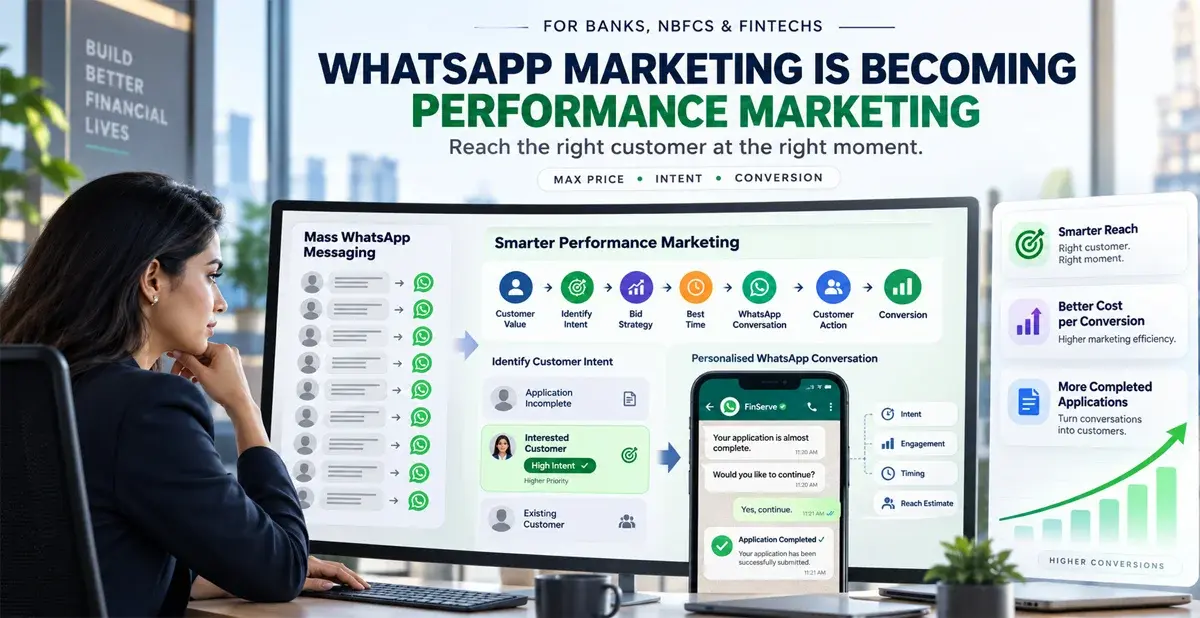
WhatsApp Marketing Bidding for Fintech in India: Meta Max Price, Timing & Delivery Guide (2026)
Meta is moving WhatsApp marketing beyond a fixed-price messaging model... Read More
Sep 22, 2026
AI Sales Agent for Travel Agencies: Convert More Travel Leads
Travel enquiries rarely arrive at a convenient time. A family may ask for a Kerala package at 10:30... Read More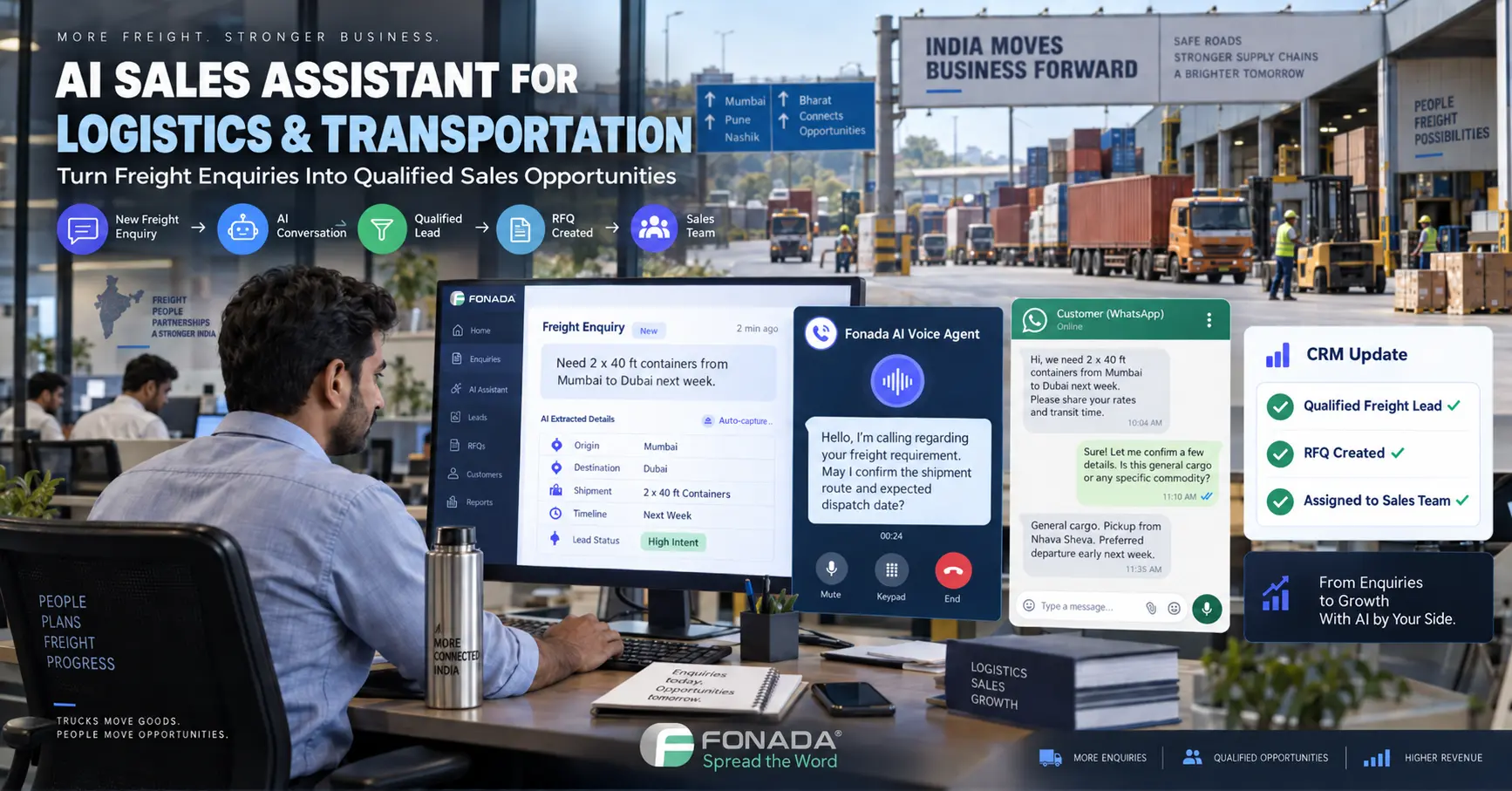
Sep 18, 2026
AI Sales Assistant for Logistics and Transportation
India’s logistics and transportation sector moves fast, but the sales process often does not.... Read MoreLatest Updates
From Fonada
Industry Insights, Trends, Innovations, Updates, and Case Studies from Industry Experts
View
Customer
Reviews
Discover why our customers love us - read their authentic and heartfelt reviews!
View
Case
Studies
Explore real-life scenarios, offering analysis, and solutions to practical challenges
View
Convert Leads Into Sales With Fonada
Trusted CPaaS Solution Provider