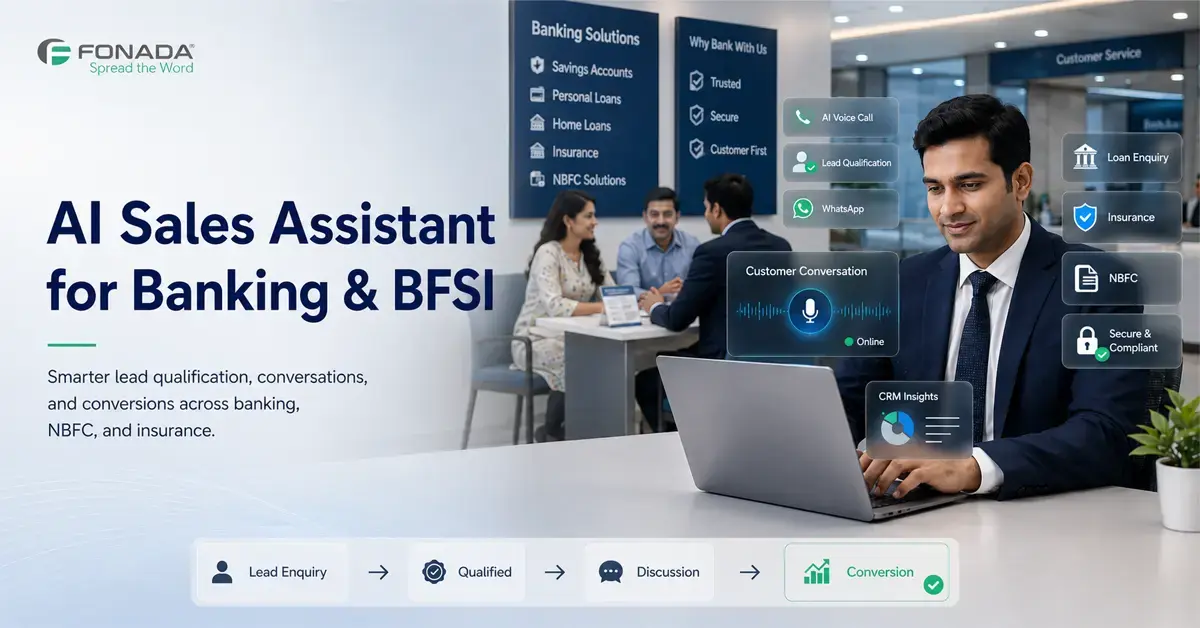
Every sales manager in India knows this feeling. Your team generated 500 leads last month from ads, website forms, and WhatsApp enquiries. But when you check the numbers at the end of the month, only 40 or 50 of those leads actually spoke to a salesperson. The rest went cold, unanswered, or simply forgot they ever filled a form.
The problem is rarely the product. The problem is speed and consistency. Human teams cannot call every lead within five minutes. They cannot work at 11 pm when a customer in Indore is browsing your website. They cannot follow up with 2,000 people on a Sunday.
An AI Sales Assistant can. That is why businesses across India, from real estate builders in Pune to D2C brands in Delhi, are adopting this technology faster than any other sales tool in recent years.
In this guide, we will explain what an AI Sales Assistant is, how it works, how it qualifies leads and books meetings on its own, and how Indian businesses are using it to close more deals.
What Is an AI Sales Assistant?
An AI Sales Assistant is a software agent that talks to your leads and customers the way a trained salesperson would. It can speak on phone calls, chat on WhatsApp, respond on your website, and send SMS or RCS messages. It understands what the customer is saying, asks the right questions, records the answers, and takes the next action without waiting for a human.
Think of it as a junior sales executive who never sleeps, never takes leave, never forgets a follow-up, and can handle thousands of conversations at the same time.
There is one important difference between an AI Sales Assistant and the old-style chatbots you may have seen on websites. Old chatbots followed fixed scripts and got confused the moment a customer typed something unexpected. Modern AI Sales Assistants are built on conversational AI and large language models. They understand natural language, including the way Indians actually speak, mixing Hindi and English in one sentence, asking questions in their own words, and changing topics mid-conversation.
Platforms like Fonada have taken this a step further by combining AI with a full communication stack. So the same assistant that chats with a lead on WhatsApp can also place an outbound voice call, verify the number, schedule a callback, and update your CRM. If you want a deeper background on how these agents evolved, our complete guide to AI sales agents covers the full journey.
Why Indian Sales Teams Are Losing Leads Right Now
Before we talk about the solution, let us be honest about the problem. Most Indian businesses do not lose deals because competitors have better products. They lose deals because of slow follow-up.
A lead contacted within the first five minutes is far more likely to convert than a lead contacted after an hour. Yet in most companies, the first response takes several hours, sometimes a full day. Here is why:
- Leads come in at all hours, but sales teams work fixed shifts. A large share of enquiries land after 7 pm, and by morning the customer has already spoken to a competitor. We wrote about this in our post on how to stop losing leads after business hours.
- Telecallers spend most of the day dialling numbers that do not pick up, leaving little time for real conversations.
- Follow-ups depend on human memory and Excel sheets. One busy week, and fifty leads quietly die.
- During a festive sale or a new launch, lead volume jumps ten times but team size stays the same.
An AI Sales Assistant attacks all four problems at once. It responds in seconds, works round the clock, follows up automatically, and scales instantly when volume rises.
How Does an AI Sales Assistant Work?
People often ask how an AI Sales Assistant actually works behind the scenes. Here is the flow in plain language.
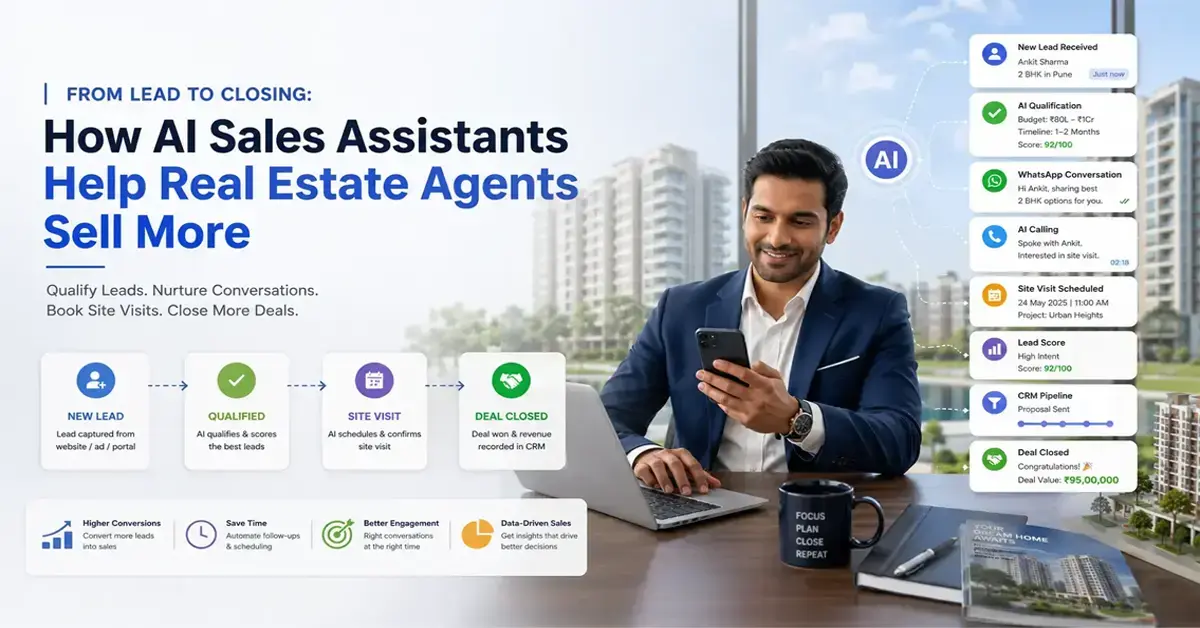
Step 1: A lead enters the system. Someone fills a form on your website, clicks a Facebook ad, sends a WhatsApp message, or gives a missed call on your virtual number. The moment this happens, the AI assistant is triggered.
Step 2: Instant first contact. Within seconds, the assistant reaches out on the same channel or the channel you prefer. It might send a WhatsApp message, place an AI voice call, or reply on the website chat. No lead waits overnight.
Step 3: Natural conversation and data capture. The assistant greets the lead, introduces your business, and starts a genuine two-way conversation. It asks qualifying questions, answers product queries, handles objections, and notes every answer.
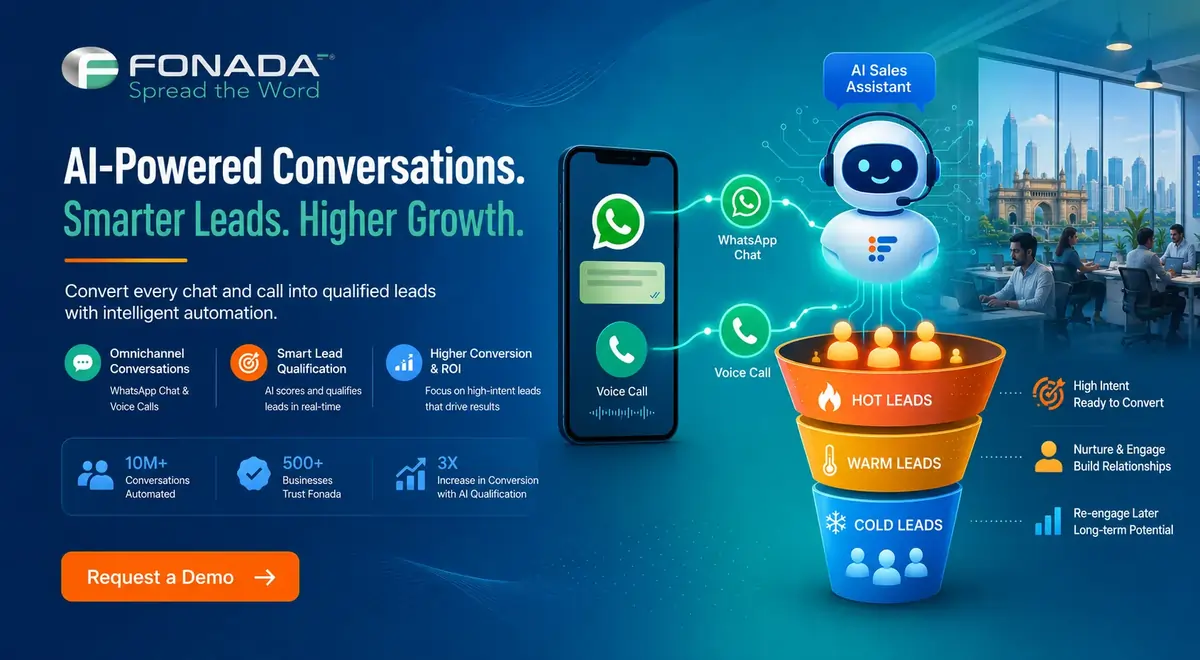
Step 4: Lead qualification and scoring. Based on the answers, the assistant scores the lead. Budget, timeline, location, intent, and authority are all evaluated against rules you define. Hot leads get flagged immediately.
Step 5: Action. For a hot lead, the assistant books a meeting directly on your sales team's calendar or transfers the call live to a human agent. For a warm lead, it schedules a follow-up sequence. For an unqualified lead, it politely closes the conversation and marks the record in your CRM.
Step 6: Follow-up and nurturing. The assistant keeps working the pipeline. Reminders before meetings, follow-ups after demos, payment nudges, and re-engagement messages for cold leads all happen automatically.
The entire cycle, from first contact to booked meeting, can finish in minutes without a single human touch. That is the real meaning of AI sales automation.
AI Lead Qualification: Separating Serious Buyers from Window Shoppers
Lead qualification is where most sales time gets wasted. Your best closers should be talking to buyers, not asking "Sir, what is your budget?" a hundred times a day.
An AI Sales Assistant handles lead qualification with a consistency no human team can match. Here is what that looks like in practice:
- Every lead gets the same quality of questioning. The assistant never skips a question because it is tired or in a hurry. It follows your qualification framework, whether that is BANT, CHAMP, or a custom checklist, on every conversation.
- Answers are captured as structured data. Instead of scribbled notes, you get clean CRM fields: budget range, city, purchase timeline, decision maker or not.
- Lead scoring happens in real time. A lead who says "I want to buy this month and my budget is 80 lakh" gets routed to a senior salesperson within minutes.
- Language is never a barrier. Good AI voice agents handle Hindi, English, Hinglish, and major regional languages, which matters enormously in a market where a buyer in Coimbatore and a buyer in Nashik both deserve a comfortable conversation.
The result is simple. Your human team stops chasing 100 percent of leads and starts focusing on the 20 percent who are ready to buy. That single shift often does more for sales productivity than hiring three extra people.
AI Meeting Booking: From Conversation to Calendar Without Back and Forth
Ask any salesperson how many messages it takes to fix one meeting. "Are you free Tuesday?" "No, Wednesday after 4." "Our team is busy Wednesday, how about Thursday?" This ping-pong can stretch across three days, and by then the buyer's interest has cooled.
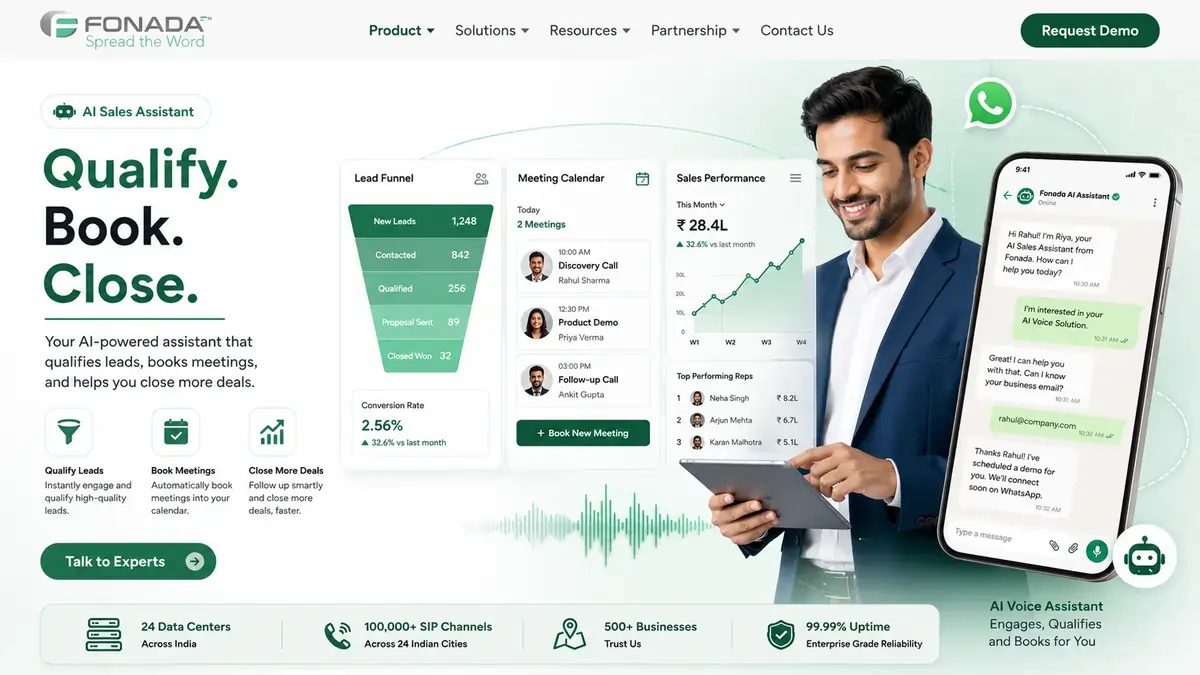
An AI Sales Assistant removes this friction completely. During the conversation itself, it checks your team's live calendar, offers the lead two or three available slots, confirms the choice, sends a calendar invite, and books the meeting. The whole thing takes under a minute.
It then protects that meeting too. A confirmation goes out on WhatsApp immediately, reminders go out a day before and an hour before, rescheduling is handled without involving your team, and silent leads get a gentle follow-up with fresh slots. No-show rates drop sharply when reminders are this consistent, and for businesses running demos or site visits, that alone changes monthly numbers.
Traditional Sales Process vs AI Sales Assistant: A Quick Comparison
| Sales Activity | Traditional Manual Process | With an AI Sales Assistant |
|---|---|---|
| First response to a new lead | 2 to 24 hours, depending on workload | Under 60 seconds, any time of day |
| Working hours | 9 am to 7 pm, six days a week | 24x7, including Sundays and festivals |
| Leads handled per day | 60 to 80 calls per telecaller | Thousands of parallel conversations |
| Lead qualification | Inconsistent, depends on the individual | Same structured questions every time |
| Meeting booking | Multiple back-and-forth messages | Booked live during the conversation |
| Follow-ups | Depends on memory and reminders | Automatic, scheduled, never missed |
| Data entry in CRM | Manual, often incomplete | Automatic and structured |
| Cost of scaling | Hire and train more people | Increase capacity with a few clicks |
| Language coverage | Limited to what the team speaks | Multiple Indian languages built in |
This table is not an argument for removing humans from sales. It is an argument for letting humans do what they are best at, which is building trust and closing, while the AI handles speed, volume, and repetition.
Key Features to Look For in an AI Sales Assistant
If you are evaluating AI sales software for your business, these are the features that separate serious platforms from basic bots:
1. Omnichannel presence. Your customers move between channels. The assistant should handle voice calls, WhatsApp, SMS, RCS, and web chat from one place, and remember the context across channels. A lead who chatted on WhatsApp yesterday should not have to repeat everything on a call today. Our guide on RCS backed by SMS explains why channel redundancy matters in India.
2. AI voice capability. Text chat is useful, but India is a voice-first market. A capable AI voice agent that speaks naturally, understands accents, and handles interruptions is essential for serious sales work.
3. WhatsApp Business API integration. With most Indian customers active on WhatsApp, your assistant must work natively on it. If you are new to this, start with our guide on how to make a WhatsApp bot and our detailed post on sending bulk WhatsApp messages the right way.
4. CRM and calendar integration. The assistant should push every conversation, score, and booking into your existing CRM and calendar automatically. Without this, you are just creating another data silo.
5. Smart call routing and live transfer. When a lead turns hot mid-conversation, the assistant should transfer the call to a human instantly, along with the full context. Pairing the AI with tools like click to call and a proper call center IVR makes this seamless.
6. Number masking and compliance. Customer privacy matters, and Indian regulations around commercial communication are getting stricter. Features like number masking and DLT-compliant messaging protect both your customers and your business.
7. Analytics and call intelligence. You should be able to see conversion rates by campaign, common objections, drop-off points, and agent performance in one dashboard.
8. No-code setup. Your marketing or operations team should be able to build and modify conversation flows without writing code or waiting for developers.
Three Real Use Cases from the Indian Market
Theory is fine, but sales leaders want proof. Here are three practical use cases showing how an AI Sales Assistant performs in Indian business conditions.
Use Case 1: Real Estate Developer in Pune
A mid-sized developer launches a new residential project and runs digital ads across Facebook, Google, and property portals. Within two weeks, 6,000 leads pour in. The in-house team of eight telecallers can barely handle 500 calls a day, and most portal leads are duplicates or casual browsers.
The developer deploys an AI voice assistant integrated with WhatsApp. Every new lead receives a call within two minutes. The assistant speaks in Hindi, Marathi, or English based on the lead's preference, shares project details, asks about budget, configuration, and purchase timeline, and books site visits directly on the sales team's calendar. Warm leads receive brochures and payment plans on WhatsApp automatically.
The pattern in such deployments is consistent: qualified site visits go up, cost per site visit comes down, and the human team spends its day with genuinely interested buyers. We have covered this playbook in our posts on AI voice bots for real estate lead generation and WhatsApp automation for real estate.
Use Case 2: D2C E-commerce Brand in Delhi
A fast-growing fashion brand in Delhi receives thousands of customer queries daily: order status, size exchanges, payment issues, and product questions. During sale events, query volume triples, carts get abandoned, and the small support team drowns.
The brand deploys a WhatsApp AI assistant that handles the full pre-sales and post-sales journey. It answers product questions, recommends sizes, recovers abandoned carts with personalised nudges, confirms cash-on-delivery orders to cut fake orders, and upsells matching products after purchase. Every conversation feeds into the CRM, so the marketing team knows exactly which products generate the most questions.
The interesting part is that the assistant does not just support sales, it actively creates them. Abandoned cart recovery alone brings back a meaningful share of lost revenue. We documented a similar journey in our case study on how e-commerce brands handle 10,000 customer queries without hiring support staff and our guide to WhatsApp chatbots for e-commerce in India.
Use Case 3: Automobile Dealership Network in Chennai
A multi-brand dealership group gets enquiries from its website, car portals, and walk-in registrations. Test drives are the lifeblood of car sales, but coordinating them is chaotic. Leads wait days for a callback, and no-shows for booked test drives are common.
The group implements an AI Sales Assistant that calls every new enquiry within minutes, understands which model and variant the customer is interested in, checks test drive slot availability at the nearest showroom, and books the slot on the spot. Reminders go out on WhatsApp, and if a customer cannot make it, the assistant reschedules instantly. Post test drive, it collects feedback and hands hot buyers to the sales manager with full notes.
For dealerships, the maths is straightforward. More test drives booked and attended means more cars sold. Our post on WhatsApp Business for the automobile industry goes deeper into this workflow.
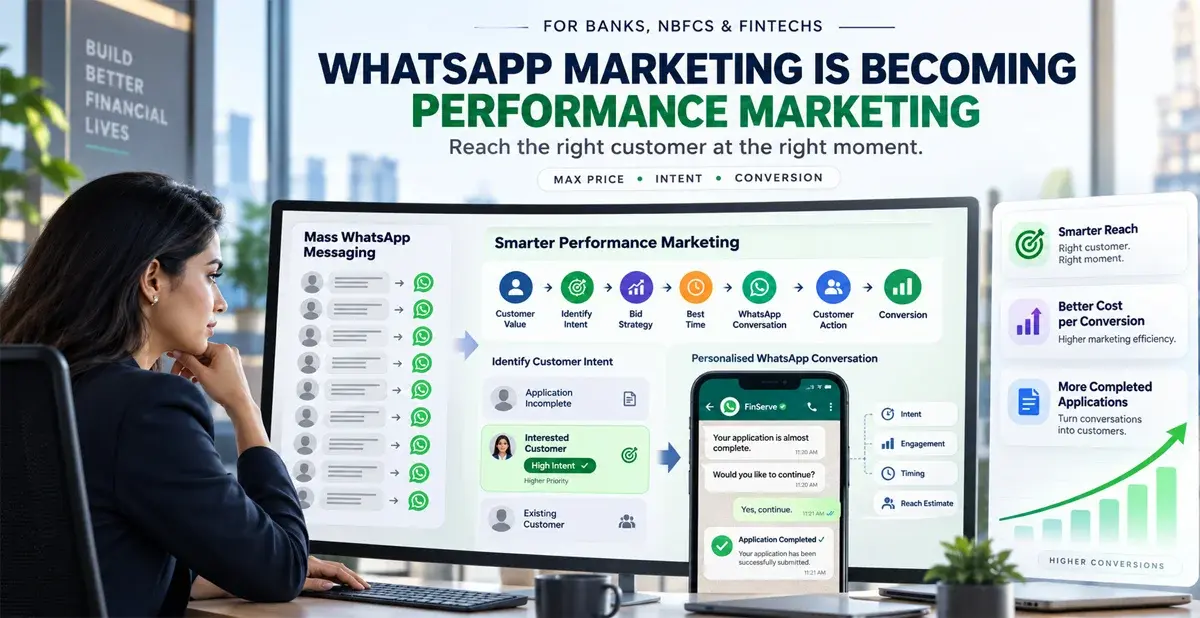
These three examples share one pattern. The AI does not replace the sales team. It removes the slow, repetitive, low-value work so the team can sell. The same pattern works for banking and NBFCs handling loan enquiries, which we covered in our piece on WhatsApp chatbots for banking, and for retail brands looking to increase customer engagement.
The Business Benefits, in Plain Numbers
When companies ask us what an AI Sales Assistant will actually change, we point to five measurable areas:
Speed to lead. First response time drops from hours to seconds. Since speed is the single biggest factor in lead conversion, this alone lifts results.
Coverage. One hundred percent of leads get contacted, qualified, and followed up. No lead dies in a spreadsheet.
Scale. During campaign spikes, the assistant absorbs the extra volume without extra hiring. One of our AI voice bots once dialled 25 lakh calls in a single day, a scale no human team can imagine.
Cost efficiency. The cost per qualified lead falls sharply because the expensive human hours are reserved for closing, not chasing. This is also why AI call centers are steadily replacing traditional setups for repetitive calling work.
Data quality. Every conversation becomes structured data. Sales leaders finally get a true picture of the pipeline, common objections, and campaign performance.
How Fonada Builds AI Sales Assistants for Indian Businesses
At Fonada, we have spent years building communication infrastructure for Indian enterprises, from IVR software for startups and SMEs to enterprise-grade SMS solutions and the WhatsApp Business API. Our AI Sales Assistant sits on top of this full CPaaS stack, which gives it a practical advantage: it is not just a chatbot, it is a complete sales workflow.
A typical Fonada deployment includes:
- AI voice agents that make and receive calls in multiple Indian languages, powered by our voice bot and text-to-speech engines.
- WhatsApp AI assistants built on the official WhatsApp Business API for qualification, nurturing, and transactions.
- Smart dialling through FonaDial, our auto dial software, so human agents only get connected calls, never dead numbers.
- Virtual numbers and missed call services for lead capture, including easy options to buy a virtual number for campaigns.
- Promotional and transactional messaging through promotional SMS and RCS for follow-up sequences.
- Full analytics covering every call, message, and conversion.
Because everything runs on one platform, your AI Sales Assistant, your human agents, and your campaigns all share the same data. That is what makes the automation feel intelligent rather than robotic. Our primer on what business communication really means explains how these channels fit together, and our overview of modern customer service software shows how sales and support increasingly share the same engine.
How to Get Started: A Simple 5-Step Plan
You do not need a big-bang transformation to begin. Most successful companies start small and expand.
Step 1: Pick one high-volume, high-leakage process. Usually this is new lead follow-up or abandoned enquiry recovery, wherever slow response is clearly costing you money.
Step 2: Define your qualification questions. Write down the five to seven questions your best salesperson asks every lead. These become the AI's script foundation.
Step 3: Choose channels. For most Indian businesses, the winning combination is AI voice calls plus WhatsApp, with SMS as backup.
Step 4: Run a pilot on a slice of leads. Send 20 to 30 percent of new leads to the AI assistant for a month and compare contact rates, qualification rates, and meetings booked against your manual process.
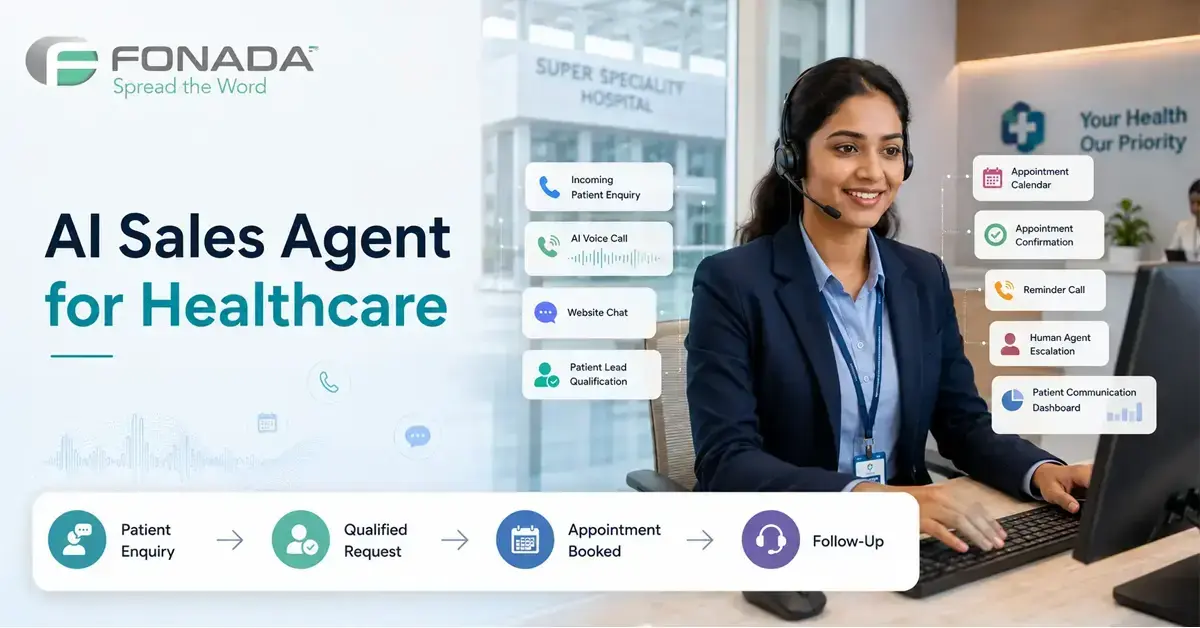
Step 5: Expand and refine. Once the pilot proves itself, extend the assistant to more campaigns, more languages, and deeper workflows like payment reminders and renewal calls. Healthcare shows how far this can go, as we explored in our post on patient engagement with SMS and IVR.
Conclusion: The Fastest Salesperson on Your Team
Sales in India has always rewarded speed, persistence, and personal attention. The irony is that human teams, however talented, cannot deliver all three at scale. An AI Sales Assistant can, and it does so without lunch breaks, attrition, or Monday blues.
The companies adopting this technology today are not replacing their sales teams. They are giving their teams superpowers: every lead answered in seconds, every follow-up on time, every meeting booked without friction, and every conversation recorded as clean data.
If your leads are leaking and your team is stretched, it is worth seeing this in action with your own campaigns and your own numbers. Request a demo with Fonada and watch an AI Sales Assistant qualify a lead and book a meeting in real time. It usually takes one demo to understand why this is the most practical sales investment of 2026.
Explore more solutions on the Fonada website here: 👉 Fonada
Get in touch with us:
👉 Contact us: https://bit.ly/47OjrVH
👉 WhatsApp: https://wa.me/7479574795?text=
👉 Subscribe on LinkedIn: https://bit.ly/4pPuQL8
👉 Subscribe A DEMO: https://calendly.com/connect-fonada/30min
FAQs
It asks structured qualifying questions about budget, timeline, location, and intent during a natural conversation, scores each lead based on the answers, and routes hot leads to human salespeople while nurturing warm leads automatically.
Yes. Modern AI voice agents place and receive real phone calls, speak naturally in multiple Indian languages including Hindi and Hinglish, handle interruptions, and can transfer a call to a human agent when needed.
Yes. Cloud-based platforms like Fonada offer no-code setup and usage-based pricing, so even startups and SMEs can deploy an AI Sales Assistant without a technical team or heavy upfront investment.
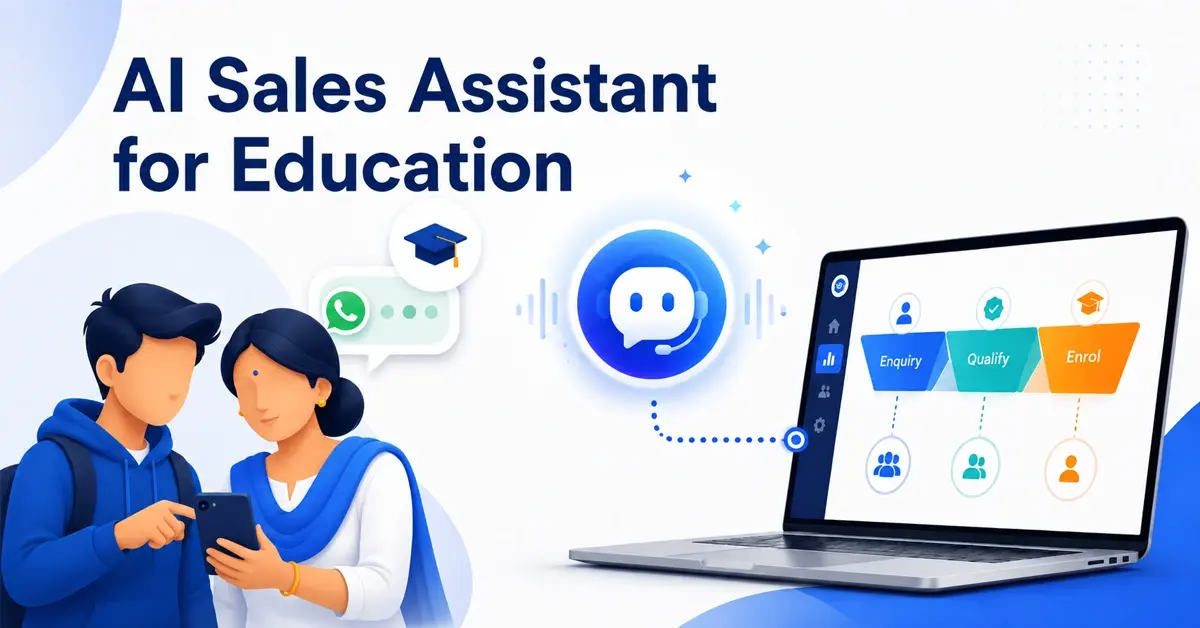
Real estate, e-commerce, automobile, banking and NBFCs, education, healthcare, and travel see the strongest results, mainly because they handle high lead volumes where response speed decides conversion.
No. It removes repetitive work like first calls, qualification, and follow-ups so your human team can focus on demos, negotiations, and closing. Companies typically see their existing team close more deals, not shrink.
Usually within 60 seconds of the lead coming in, on any day and at any hour. This instant response is one of the biggest reasons conversion rates improve after deployment.
Yes. Built on the official WhatsApp Business API, it can qualify leads, share catalogues and brochures, recover abandoned carts, send reminders, and book meetings directly inside WhatsApp.
The assistant checks your team's live calendar during the conversation, offers available slots to the lead, confirms the booking, sends calendar invites, and manages reminders and rescheduling automatically.
Pricing depends on call volumes, channels, and features, and most platforms follow usage-based models. The practical way to evaluate cost is against the revenue currently lost to slow follow-up, which is usually far higher. You can request a customised quote through a Fonada demo.
An AI Sales Assistant is a software agent powered by conversational AI that talks to leads and customers over voice calls, WhatsApp, SMS, and web chat. It qualifies leads, answers questions, books meetings, and follows up automatically, working alongside your human sales team.
Share
.gif "Side Bar Gif")
Subscribe To Our Newsletter
Get updates and learn from the best
Sep 22, 2026
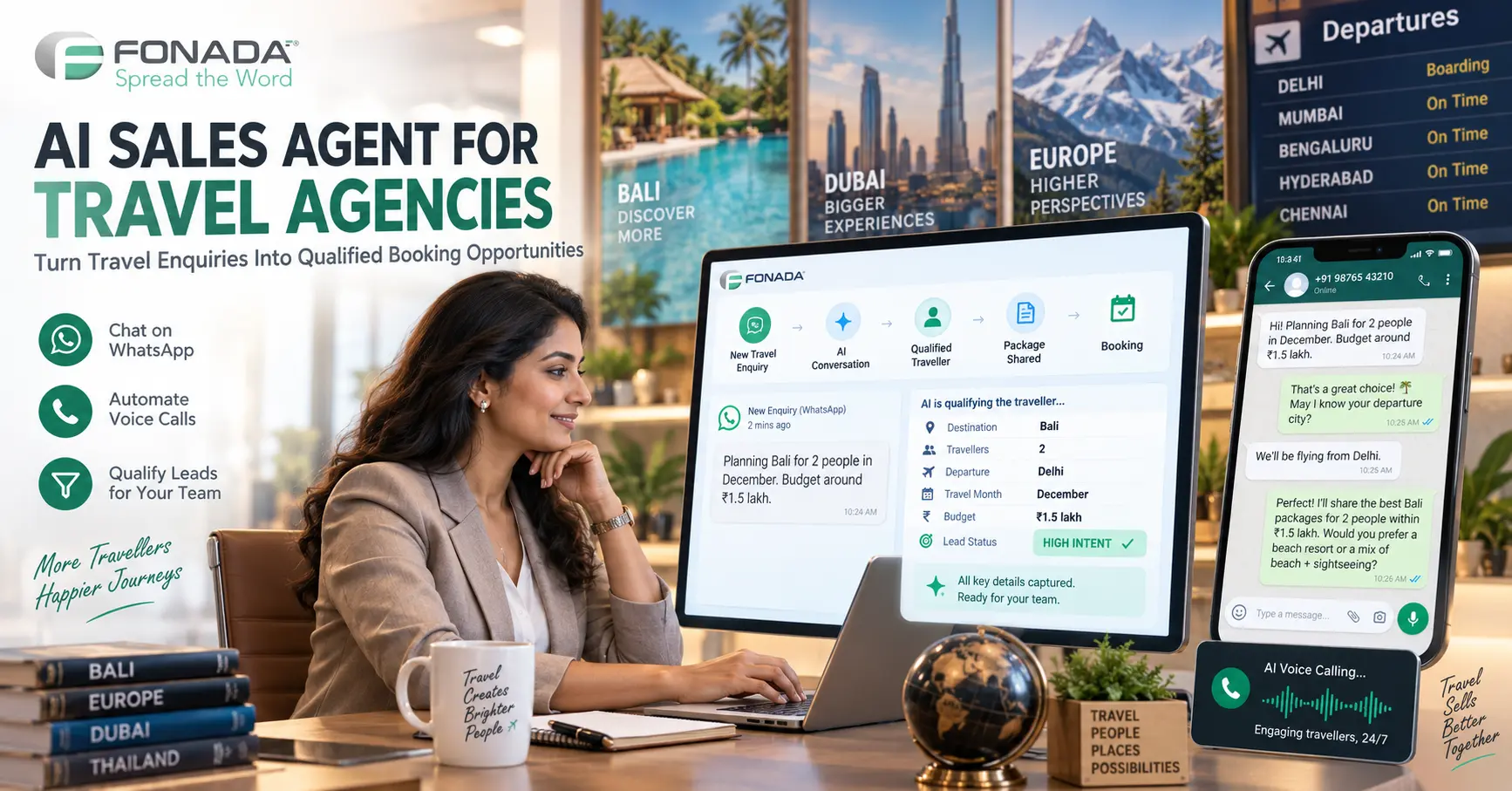
AI Sales Agent for Travel Agencies: Convert More Travel Leads
Travel enquiries rarely arrive at a convenient time. A family may ask for a Kerala package at 10:30... Read More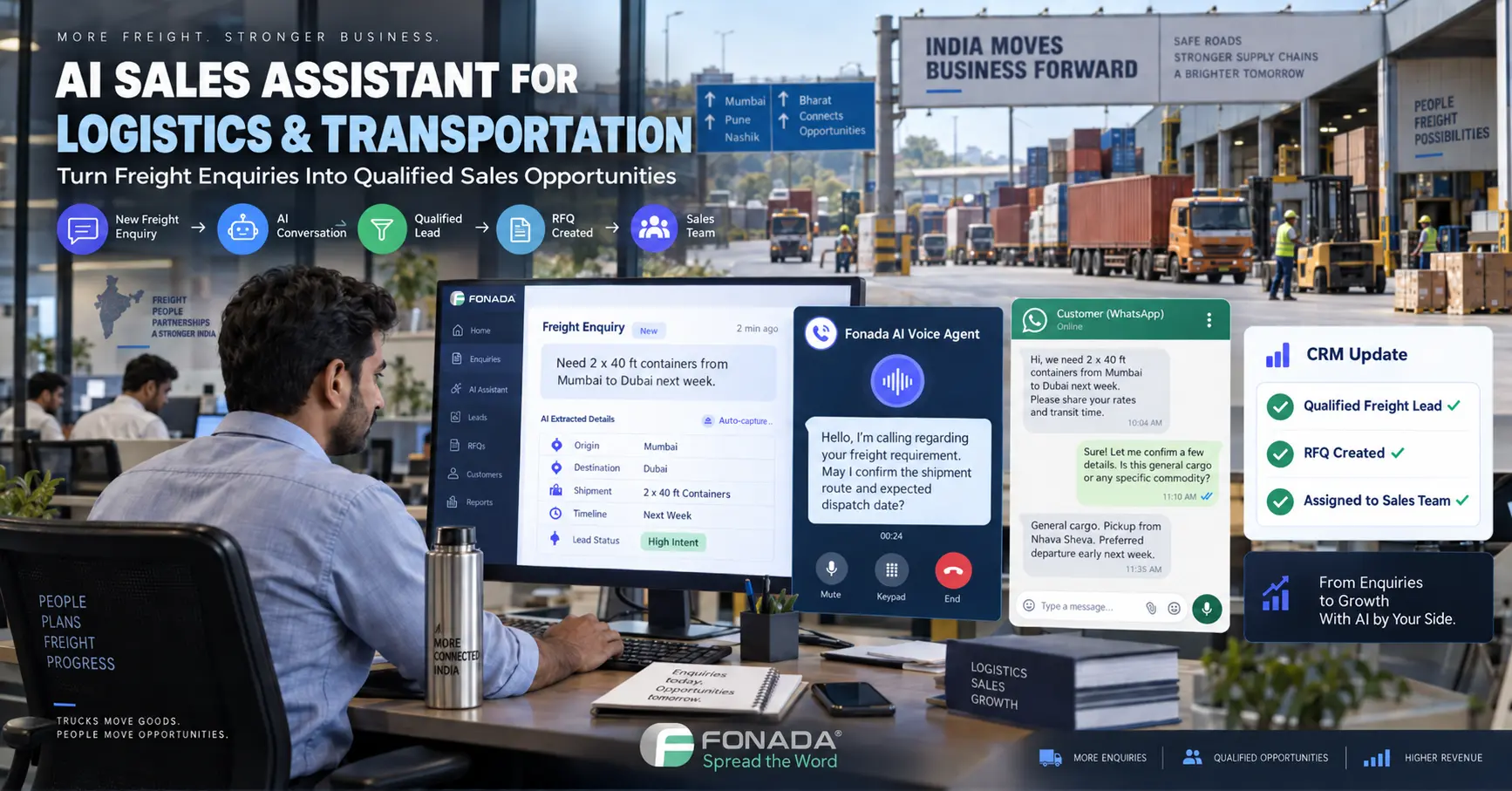
Sep 18, 2026
AI Sales Assistant for Logistics and Transportation
India’s logistics and transportation sector moves fast, but the sales process often does not.... Read More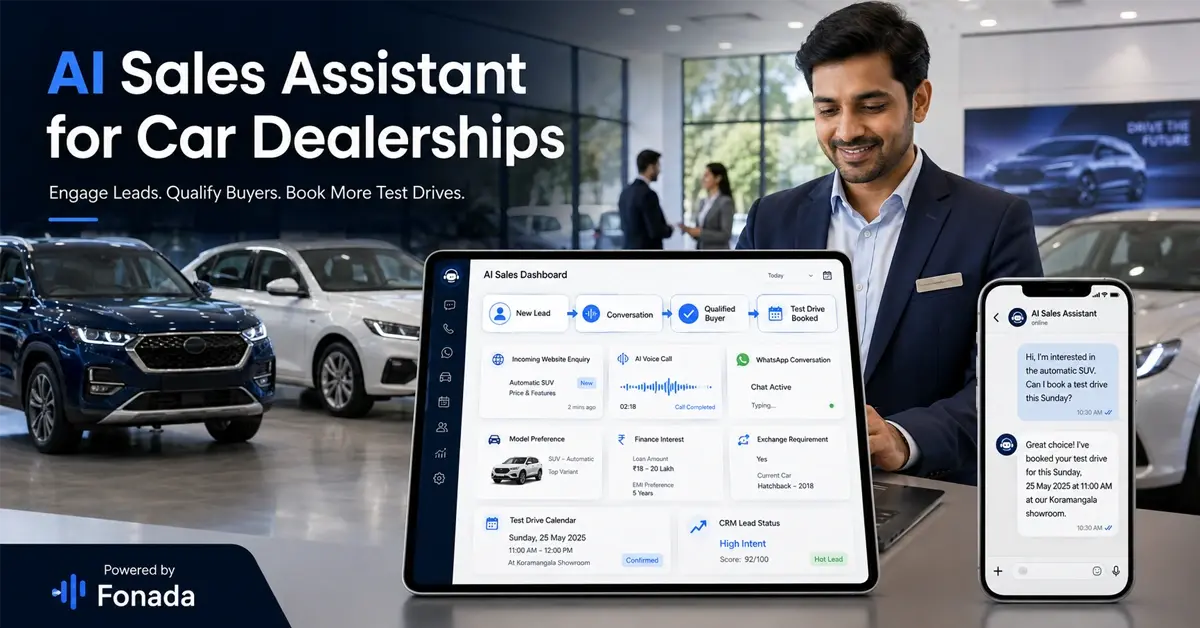
Sep 02, 2026
AI Sales Assistant for Car Dealerships: How AI Can Turn More Enquiries into Test Drives and Sales
Buying a car in India rarely starts at the showroom today. A customer... Read MoreLatest Updates
From Fonada
Industry Insights, Trends, Innovations, Updates, and Case Studies from Industry Experts
View
Customer
Reviews
Discover why our customers love us - read their authentic and heartfelt reviews!
View
Case
Studies
Explore real-life scenarios, offering analysis, and solutions to practical challenges
View
Convert Leads Into Sales With Fonada
Trusted CPaaS Solution Provider