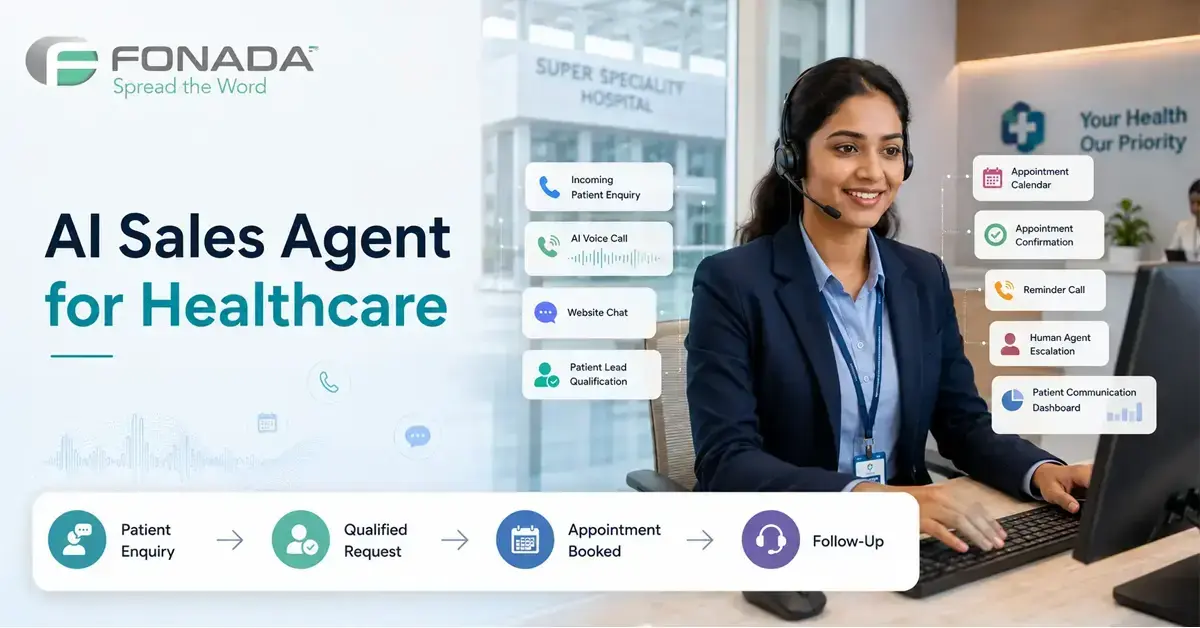
AI Sales Agent for Healthcare
Healthcare organisations receive enquiries every day through websites, calls, advertisements, WhatsApp, referral campaigns, and appointment forms. A patient may be looking for a doctor, a diagnostic test, a dental procedure, a health package, or simply the next available appointment. If nobody responds quickly, that person may call another hospital or clinic.
An AI Sales Agent for Healthcare can help healthcare teams manage these early conversations faster. It can respond to enquiries, understand basic requirements, qualify leads, schedule appointments, send reminders, follow up with interested patients, and transfer complex conversations to a human team.
The important point is simple. AI should support patient access and administrative communication. It should not replace doctors, diagnosis, medical judgement, or emergency care.
What is an AI Sales Agent for Healthcare?
An AI sales agent for healthcare is a conversational system that supports patient acquisition and engagement through voice, phone, website chat, or messaging channels. It can work as an AI Healthcare Assistant, AI voice agent for healthcare, healthcare virtual agent, or AI receptionist depending on the workflow.
This is different from asking AI to provide medical advice. A responsible healthcare AI sales agent stays within approved information, uses clear escalation rules, and sends clinical questions to qualified healthcare professionals.
For a broader understanding of sales automation, read Fonada’s guide on how AI sales assistants qualify leads, book meetings, and support deal conversion.
Why healthcare organisations need faster patient response
Patient Lead Generation is only useful when enquiries are handled properly. Many hospitals and clinics invest in search ads, social media, health portals, local marketing, and referral campaigns. However, the journey can break after the lead arrives.
Healthcare call center automation can reduce these gaps by giving patients an immediate first response and collecting the information needed for the next step.
How an AI Healthcare Assistant works
The exact workflow depends on the organisation, but a practical setup usually follows a simple path.
First, the AI receives an enquiry through a call, website, form, or messaging channel. It identifies the purpose of the enquiry and asks only relevant administrative questions. It may then check an approved scheduling system, offer available slots, record the request, and send confirmation.
If the patient asks a clinical question, reports an emergency, or needs support beyond the approved workflow, the conversation should be transferred or redirected to the appropriate human team.
Where an AI sales agent can help
1. Patient lead capture
A healthcare website may receive visitors throughout the day, but not every visitor wants to fill a long form. An AI agent can start a short conversation and help capture enquiries.
This can improve Healthcare Website Conversion because the visitor receives guidance while interest is still fresh.
2. Patient lead qualification
AI lead qualification does not need to be complicated. The system can ask basic questions such as location, required department, preferred appointment date, and whether the enquiry is for the patient or someone else.
The goal is not to judge medical need. It is to route the enquiry to the right administrative or healthcare team.
3. Appointment scheduling
AI appointment scheduling for healthcare can reduce repetitive calls between patients and reception teams. An AI appointment booking agent can collect preferences, offer approved slots when connected to the scheduling system, and confirm the booking.
4. Appointment reminders
Missed appointments affect both patients and healthcare operations. Automated appointment reminder calls can remind patients about an upcoming visit and provide a simple way to confirm, reschedule, or contact the clinic.
An AI appointment reminder system can support no-show reduction, but reminders should always follow the organisation’s communication and consent policies.
5. Patient follow-up
AI patient follow-up can support non-clinical tasks after an enquiry or appointment. For example, the system can check whether a person still wants to book a consultation, remind them about a pending scheduling step, or share approved instructions from the organisation.
Clinical follow-up should remain under the supervision and rules of qualified healthcare professionals.
6. Patient support and access
AI Patient Support can help people reach the right department faster. A patient access AI agent may handle common questions about location, appointment timing, service availability, contact details, or administrative processes.
Common healthcare AI use cases
| Healthcare use case | Common problem | How AI can support |
|---|---|---|
| Hospital appointment enquiries | High call volumes and delayed responses | Answer basic enquiries and support appointment booking |
| Diagnostic centres | Repetitive booking and timing questions | Capture test enquiries and schedule approved slots |
| Clinics | Small front-desk teams | Act as a virtual receptionist for routine calls |
| Patient acquisition campaigns | Leads arrive outside working hours | Provide quick first response and qualification |
| Appointment reminders | Manual reminder workload | Run automated patient reminder calls |
| Website enquiries | Visitors leave without taking action | Start conversations and guide visitors to booking |
| Contact centres | Repeated administrative questions | Automate common interactions and route complex cases |
India use case 1: Multi-speciality hospital appointment enquiries
Consider a multi-speciality hospital in Delhi, Mumbai, Bengaluru, or Hyderabad running digital campaigns for different departments. Enquiries may arrive from many channels at the same time.
An AI voice agent for hospitals can answer the first call, understand which department the patient wants, collect basic booking details, and guide the person to an appointment workflow. If the question is clinical, the agent can route it to the correct human team instead of attempting an answer.
India use case 2: Diagnostic centre booking automation
Diagnostic chains often handle repeated questions about centre locations, appointment timings, home collection availability, and booking status.
An AI voice agent for diagnostic centers can manage approved administrative questions and help with diagnostic appointment automation. It can also make reminder calls before a scheduled visit or collection.
This is particularly useful for organisations operating across several Indian cities, where the contact centre needs to handle many similar conversations consistently.
India use case 3: Dental and speciality clinics
A dental clinic, eye clinic, skin clinic, or other speciality practice may have a small reception team. During busy hours, the same team may be helping walk-in patients while also answering calls.
An AI receptionist for clinics can capture new enquiries, ask which service the person is interested in, and help schedule a consultation. Dental patient follow-up automation can also remind people about appointments or reconnect with enquiries that did not complete a booking.
The receptionist remains important. AI simply handles routine volume so staff can give more attention to patients already at the clinic.
India use case 4: Telehealth appointment access
Telehealth providers may receive enquiries from patients across different cities and time zones. An AI agent for telehealth can support appointment discovery, booking, reminders, and basic platform guidance.
It can also help identify when a conversation needs a human support executive or healthcare professional. This keeps the AI focused on access and administration rather than clinical decision-making.
AI voice agent versus traditional IVR
Traditional IVR normally asks callers to press numbers and move through a fixed menu. Healthcare voice AI can make the interaction more conversational by allowing the caller to explain what they need in ordinary language.
That does not mean IVR has no value. IVR remains useful for predictable routing and structured call flows. AI voice agents are more suitable when an organisation wants flexible conversations, qualification, scheduling, and follow-up.
Healthcare teams can learn more about Fonada IVR software and call centre IVR solutions when comparing approaches.
Outbound AI calling for healthcare
Outbound AI voice agent healthcare workflows can support approved patient engagement activities such as appointment reminders, enquiry follow-up, health programme callbacks, and administrative notifications.
An AI calling agent for healthcare can work through a prepared workflow and capture responses. Interested or complex cases can then move to a human team.
Fonada’s article on healthcare patient engagement with SMS and IVR gives additional context on healthcare communication channels.
Can AI support healthcare sales automation?
Yes, but healthcare sales automation should be designed differently from ordinary product sales.
Patients are not simply sales leads. Communication should be respectful, relevant, transparent, and sensitive to the situation. An AI sales calling agent can support enquiry response, patient acquisition, lead qualification, appointment booking, and follow-up, but it should not pressure people into healthcare decisions.
Patient access is bigger than lead generation
AI patient access can help people find the correct contact point, book an appointment, understand the next administrative step, and avoid unnecessary waiting. Patient communication AI can also make routine information easier to obtain outside normal reception hours.
How Fonada can support healthcare communication
Fonada provides communication and automation capabilities across voice and messaging that businesses can use to build structured customer engagement workflows.
Healthcare organisations can evaluate where AI voice, automated calling, messaging, IVR, or contact centre automation fits their patient access process. A sensible starting point is a narrow administrative use case such as appointment enquiries, reminders, or lead follow-up.
What should healthcare teams measure?
Do not judge an AI healthcare project only by the number of calls made. Measure whether it improves the patient journey.
Useful operational measures can include response time, answered enquiry rate, appointment booking rate, appointment confirmation rate, transfer rate, unresolved enquiry rate, and patient feedback.
Teams should also review conversations regularly. This helps identify unclear scripts, incorrect routing, missing information, and situations where human escalation should happen earlier.
Final thoughts
An AI Sales Agent for Healthcare can help hospitals, clinics, diagnostic centres, telehealth providers, and other healthcare organisations manage patient enquiries more efficiently.
It can support Patient Lead Generation, Patient Engagement, Healthcare Website Conversion, AI Patient Support, appointment booking, follow-up, reminders, and contact centre automation.
The best healthcare AI does not try to act like a doctor. It works as a reliable administrative assistant that knows its limits.
When healthcare organisations combine useful automation with clear human escalation, they can respond faster without losing the personal care patients expect.
Fonada can be explored as part of this communication strategy for organisations looking at voice, messaging, and AI-led engagement. Visit Fonada or request a demo to discuss a suitable workflow for your organisation.
Explore more solutions on the Fonada website here: 👉 Fonada
Get in touch with us:
👉 Contact us: https://bit.ly/47OjrVH
👉 WhatsApp: https://wa.me/7479574795?text=
👉 Subscribe on LinkedIn: https://bit.ly/4pPuQL8
👉 Subscribe A DEMO: https://calendly.com/connect-fonada/30min
FAQs
Yes. When connected to an approved scheduling workflow, an AI appointment booking agent can collect preferences, offer available slots, confirm appointments, and help patients reschedule when supported.
Yes. AI can support approved outbound calls for appointment reminders, enquiry follow-up, administrative notifications, and patient engagement. Organisations should define consent, privacy, escalation, and communication rules before deployment.
They can send or make timely appointment reminders and allow patients to confirm or request rescheduling. This can make appointment communication more consistent.
They can be suitable for administrative workflows such as appointment enquiries, routing, reminders, and common information. Clinical questions and emergencies should be handled through appropriate healthcare professionals and established processes.
IVR usually follows fixed menus and keypad inputs. A healthcare AI voice agent can understand natural spoken requests and hold a more flexible conversation while following approved rules.
Cost depends on factors such as call volume, channels, integrations, languages, workflow complexity, and support requirements. Healthcare organisations should ask providers for pricing based on their specific use case.
An AI sales agent for healthcare is a conversational system that helps manage patient enquiries, qualification, appointment booking, follow-up, and other approved administrative interactions through voice or digital channels.
Share
.gif "Side Bar Gif")
Subscribe To Our Newsletter
Get updates and learn from the best
Sep 18, 2026
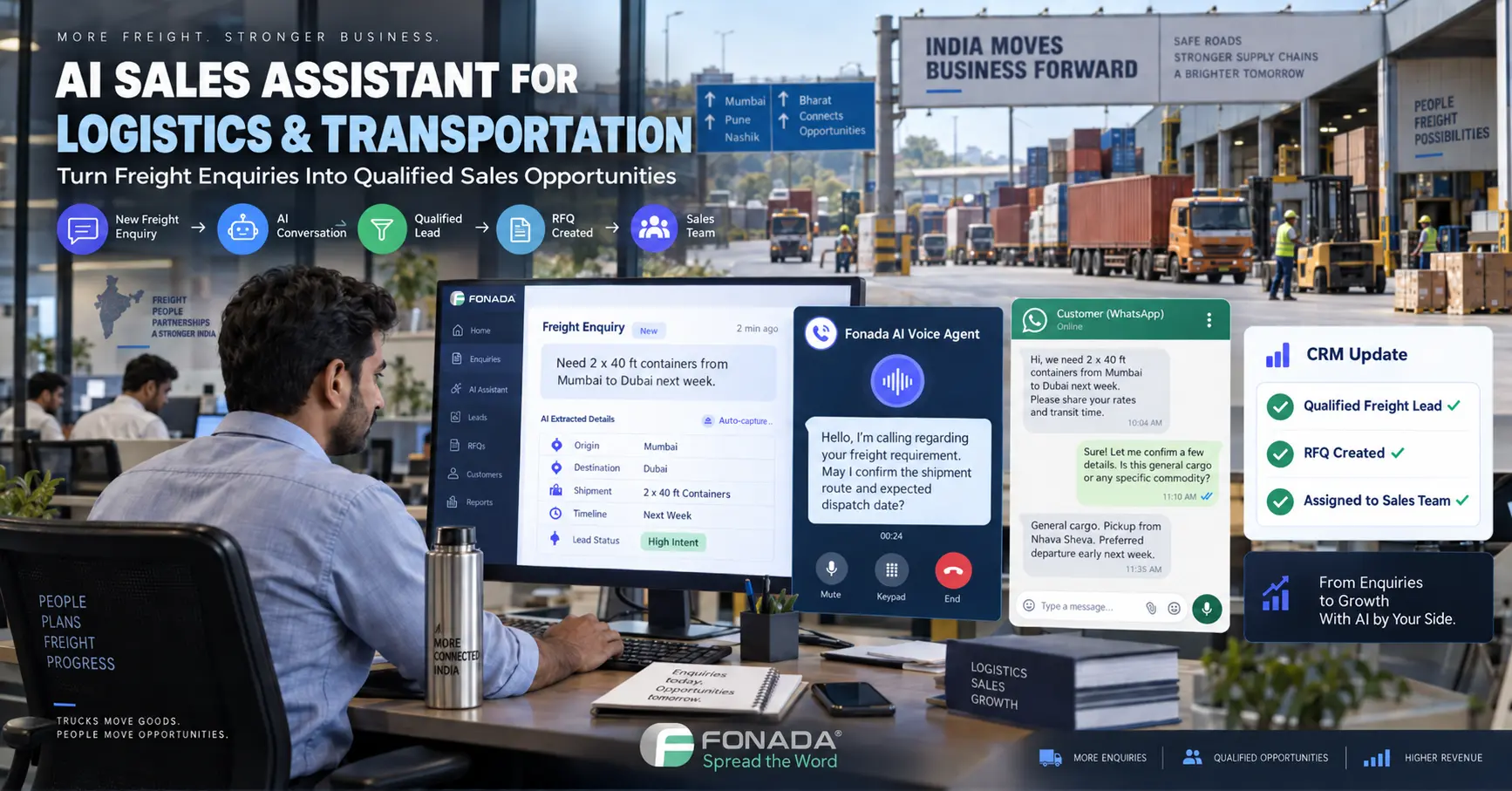
AI Sales Assistant for Logistics and Transportation
India’s logistics and transportation sector moves fast, but the sales process often does not.... Read More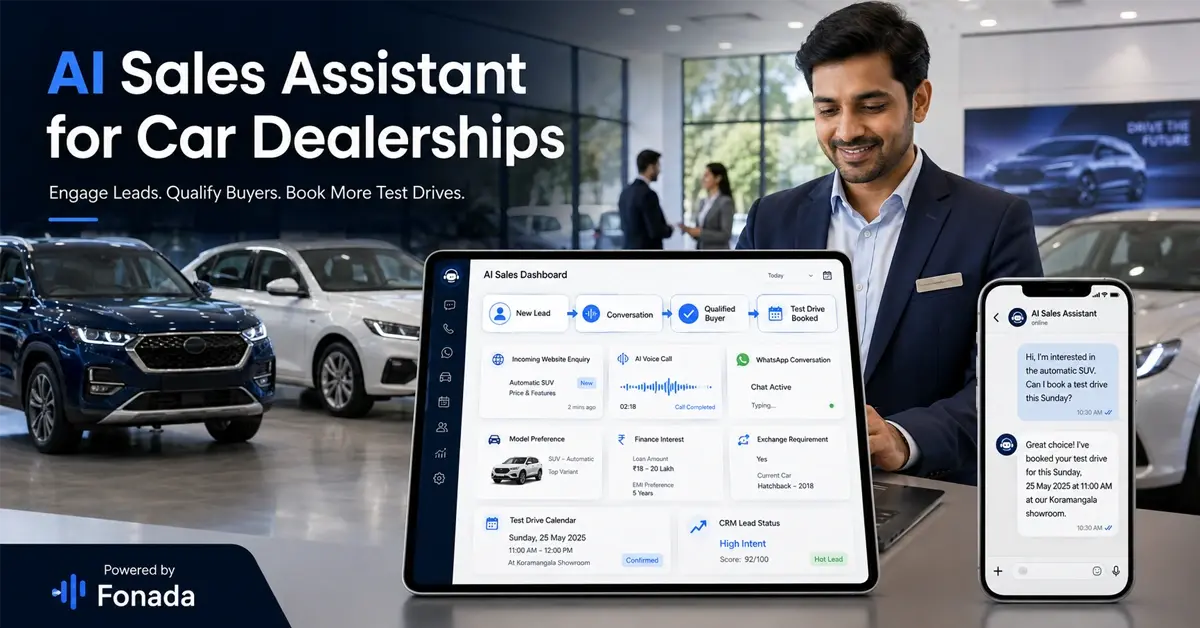
Sep 02, 2026
AI Sales Assistant for Car Dealerships: How AI Can Turn More Enquiries into Test Drives and Sales
Buying a car in India rarely starts at the showroom today. A customer... Read More
Sep 01, 2026
AI Sales Agent for Education: Convert More Enquiries
It is admission season. Your phone will not stop ringing. Your WhatsApp Business number has forty un... Read MoreLatest Updates
From Fonada
Industry Insights, Trends, Innovations, Updates, and Case Studies from Industry Experts
View
Customer
Reviews
Discover why our customers love us - read their authentic and heartfelt reviews!
View
Case
Studies
Explore real-life scenarios, offering analysis, and solutions to practical challenges
View
Convert Leads Into Sales With Fonada
Trusted CPaaS Solution Provider