Blog
AI Sales Agent for Travel Agencies: Convert More Travel Leads
September 22, 2026
8 min read
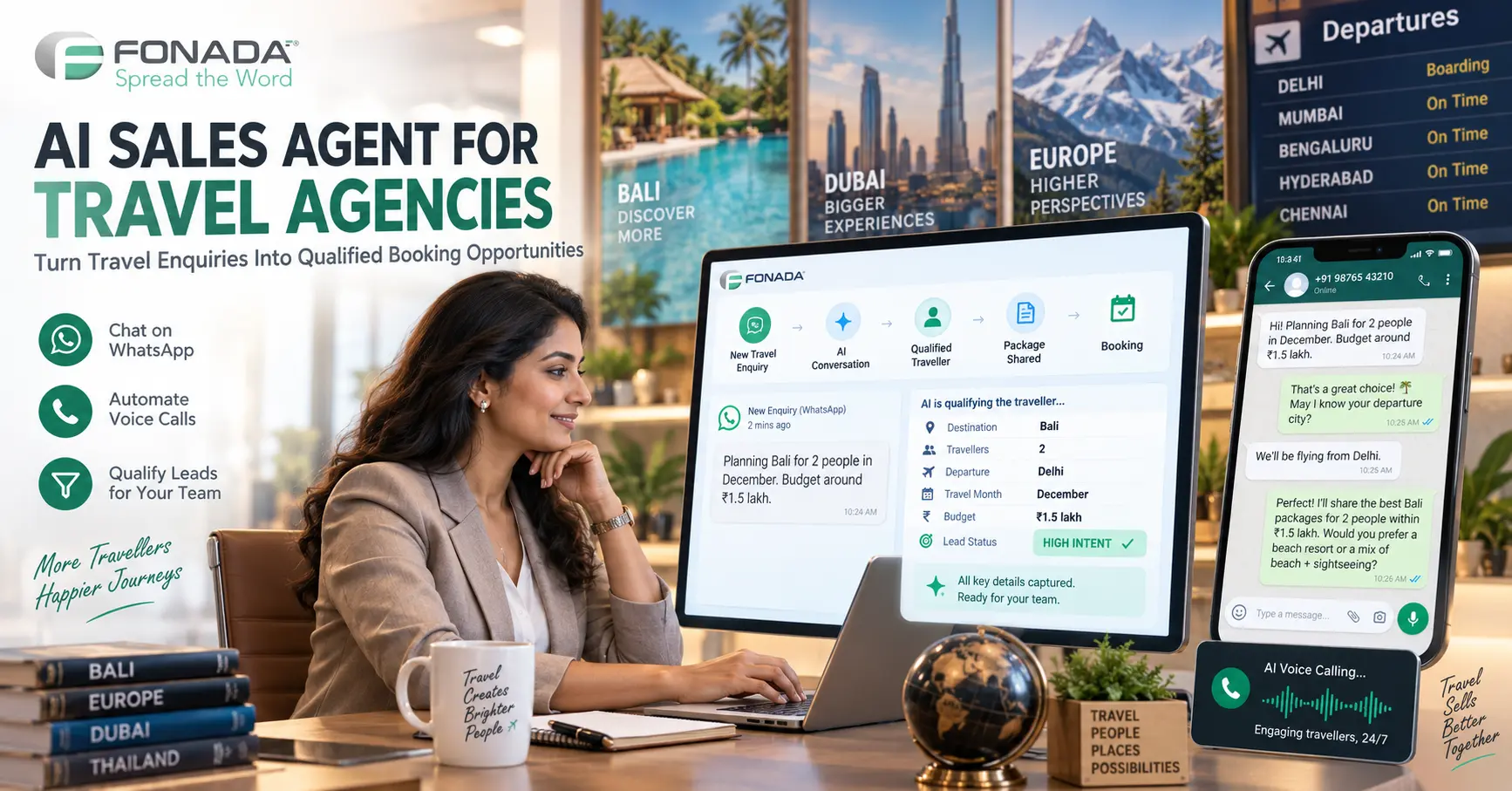
Travel enquiries rarely arrive at a convenient time. A family may ask for a Kerala package at 10:30 PM. A honeymoon couple may compare Bali, Thailand, and Vietnam on WhatsApp. A corporate traveller may want a quick callback before confirming flights. By the time a salesperson responds, that traveller may already be speaking with three other agencies.
This is why an AI Sales Agent for Travel Agencies is becoming useful for Indian travel businesses. It can respond quickly, ask relevant questions, qualify intent, follow up automatically, and move serious prospects towards a human travel consultant. The aim is not to remove the personal touch. Travel is emotional, complex, and often expensive. The aim is to make sure good leads do not disappear because the team was busy, offline, or following up manually.
India is a strong market for this shift. Ministry of Tourism data shows 4.287 billion domestic tourist visits in 2025 and 32.83 million Indian national departures. Google and Kantar research published for 2026 says 85% of surveyed Indian travellers prefer to book trips online when given the choice. Agoda also reported in 2026 that 68% of Indian travellers were likely to use AI while planning their next trip. These trends do not mean customers want zero human support. They mean customers increasingly expect fast, digital, personalised assistance before they speak with a person.
For travel agencies, tour operators, destination management companies, holiday planners, visa consultants, and travel sales teams, the commercial question is simple: how many enquiries become conversations, qualified leads, quotations, and bookings?
What is an AI Sales Agent for Travel Agencies?
An AI Sales Agent for Travel Agencies is a conversational system that can engage travel prospects through voice, WhatsApp, web chat, or other connected channels. It can ask questions, capture requirements, answer approved queries, record customer details, schedule follow-ups, and transfer qualified opportunities to sales teams.
A good travel sales agent does more than send an automated greeting. It understands the purpose of the enquiry and moves the conversation forward.
For example, a traveller asking, “Dubai package kitne ka padega?” may need several questions before a useful quotation can be prepared. The AI can ask travel dates, city of departure, number of adults and children, trip duration, hotel category, approximate budget, visa requirement, and preferred activities. Once those details are captured, the human consultant receives a much better lead.
This is where AI for Travel Agencies becomes different from basic autoresponders. A rule-based reply can say, “Our team will contact you shortly.” An AI agent can continue the conversation and collect information that helps the team sell.
Travel businesses can also connect the AI layer with CRM systems, lead forms, websites, telephony, and messaging workflows. This makes Travel Agency Automation useful across the entire lead journey, not only at the first message.
Why Travel Agencies Lose Good Leads
Travel Agency Lead Generation is rarely the only problem. Many agencies already receive enquiries from Google Ads, Meta Ads, Instagram, Justdial, referrals, websites, portals, and WhatsApp campaigns. The bigger issue is what happens after the lead arrives.
A typical sales team may face five problems.
First, response time becomes slow during peak enquiry periods. Second, salespeople spend time asking the same basic questions repeatedly. Third, follow-ups depend on individual discipline. Fourth, leads from different channels are not always recorded cleanly. Fifth, teams often treat every enquiry similarly even when buying intent is very different.
A person asking for “best places in Europe” should not be handled exactly like someone saying, “We are four people, travelling from Delhi on 12 December, budget ₹2 lakh, please share Switzerland options today.”
Travel lead management improves when the agency can identify intent early.
An AI Travel Agent can help classify enquiries into categories such as exploring, price checking, itinerary requested, ready for quotation, payment pending, reschedule required, or human assistance needed. This makes prioritisation easier for the sales team.
It also supports after-hours lead capture. Fonada has explained this broader problem in its guide on how to stop losing leads after business hours with Fonada AI. For travel companies, this matters because customers often research holidays at night, on weekends, and during lunch breaks rather than during a fixed sales shift.
How an AI Sales Agent Handles a Travel Lead
A practical AI sales flow should feel natural. It should not interrogate the traveller or dump too much information at once.
Imagine a lead comes from a Meta campaign for a Maldives honeymoon package.
The AI WhatsApp agent can start with a short response:
“Hi, thanks for your Maldives enquiry. I can help you shortlist the right package. What month are you planning to travel?”
Once the traveller replies, the AI can continue step by step. It may ask departure city, number of nights, approximate budget, meal preference, resort category, and whether flights should be included.
If the customer prefers a phone conversation, an AI Voice Agent for Travel Agencies can call automatically, confirm the same details, and update the lead record.
If the prospect is high intent, the system can notify a human consultant. If the customer is still exploring, it can schedule follow-ups rather than forcing an immediate sales call.
This is Travel Lead Automation in a useful form. The technology handles repetitive qualification and reminders, while people handle itinerary design, negotiation, exceptions, destination expertise, relationship building, and final closure.
Agencies exploring this model can also read Fonada’s AI sales agents complete guide and its guide on how an AI sales assistant can qualify leads, book meetings, and close deals.
Travel Agency Automation Across the Sales Funnel
| Stage | Manual challenge | AI-supported action | Sales outcome |
|---|---|---|---|
| New enquiry | Slow first response | Instant WhatsApp, web, or voice engagement | More leads contacted |
| Qualification | Repetitive questions | Capture destination, dates, budget, travellers, preferences | Better lead quality |
| Follow-up | Leads forgotten | Automated reminders and follow-up conversations | More active opportunities |
| Quotation stage | Customer goes silent | Check interest, objections, and revised requirements | Faster re-engagement |
| Booking | Repeated confirmations | Send reminders and capture next action | Lower drop-off |
| Post-booking | Routine queries | Share approved updates or route support requests | Better customer experience |
The important point is that Travel Agency Automation should support the sales process, not create another disconnected tool. The information collected by an AI agent should reach the same CRM or lead management system used by the team.
This is why travel CRM, Travel Agency CRM, WhatsApp CRM for travel agents, and AI lead management are closely connected topics. A CRM stores the opportunity. The AI agent keeps the conversation moving.
Use Case 1: Domestic Holiday Package Agency
Consider a Delhi travel agency generating leads for Kashmir, Kerala, Goa, Himachal, and Andaman packages through Meta and Google campaigns.
The team may receive hundreds of enquiries containing only a name, phone number, and destination. Calling every lead manually takes time, and many people do not answer the first call.
An AI calling agent for a travel agency can contact new leads quickly and ask a short set of qualification questions. It can confirm destination, travel month, departure city, number of travellers, budget range, and whether the traveller wants flights.
At the same time, WhatsApp automation for travel agencies can continue the conversation if the customer does not want to speak immediately.
High-intent prospects can be transferred to experienced holiday consultants. Early-stage leads can enter an automated travel lead follow-up sequence.
The agency therefore spends less consultant time on basic data collection and more time building packages for people who have shown real intent.
Use Case 2: International Holiday and Visa Sales
International travel leads usually require more explanation. Customers may ask about visas, flights, hotel areas, insurance, transfers, forex, cancellation terms, and destination rules.
An AI Travel Agency Software workflow can capture initial requirements before a consultant joins.
For example, a traveller asking for a Europe trip can be asked whether the trip is for honeymoon, family, group, or solo travel. The AI can capture tentative dates, passport status, countries of interest, duration, budget, and preferred departure airport.
Sensitive or changing matters such as visa eligibility, immigration rules, final pricing, and legal requirements should be handled from approved sources or escalated to a qualified human. This is important for trust.
The benefit is not that AI “knows everything.” The benefit is that the agency reaches the human conversation with better context.
Use Case 3: Tour Operators and Group Departures
Tour operators often sell fixed departures, pilgrimage tours, student groups, senior citizen tours, corporate offsites, and destination-specific packages.
Here, AI Agents for Travel Agencies can help at scale.
Suppose a tour operator launches a 40-seat Dubai group departure. Leads may ask the same questions about dates, price, meals, visa, flights, hotel category, and itinerary.
A WhatsApp chatbot for travel agency sales can answer approved FAQs, capture interest, and mark people who are ready for a callback. An AI phone agent can follow up with people who opened a campaign but did not complete the enquiry.
Before departure, the same communication infrastructure can support confirmation calls and reminders. Fonada’s guides on bulk WhatsApp messages, how to make a WhatsApp bot, and business communication provide useful background for teams building these workflows.
Why WhatsApp Automation Matters for Travel Agencies
WhatsApp is often where Indian travel conversations actually happen. Customers share passports, screenshots, hotel preferences, flight options, payment confirmations, and family requirements in the same thread.
That makes WhatsApp Automation for Travel Agencies more valuable than a simple promotional broadcast.
An AI WhatsApp Agent for Travel Agencies can qualify a fresh lead, answer common questions from approved information, remind the customer about a quotation, collect preferred callback time, and route complex enquiries to staff.
It can also reduce fragmented follow-up. Instead of a salesperson manually remembering who asked for a revised Goa package three days ago, the workflow can trigger the next message based on lead status.
Travel companies planning WhatsApp workflows can also review Fonada resources on WhatsApp chatbot for ecommerce in India, WhatsApp chatbot for banking, WhatsApp chatbot for retail customer engagement, and WhatsApp Business for the automobile industry. The industries differ, but the automation principles around consent, qualification, templates, routing, and CRM updates are transferable.
Where AI Voice Agents Fit
Not every traveller wants to type ten messages. Voice remains useful when the enquiry is urgent, detailed, or easier to explain verbally.
An AI Voice Agent for Travel Agencies can make outbound calls to new leads, reconnect with unresponsive prospects, confirm interest in a quotation, ask whether travel dates changed, and schedule a human callback.
Voice is particularly useful when an agency handles large lead volumes from campaigns. Instead of making consultants dial every lead, the AI can handle the first contact and identify people who want a serious discussion.
Fonada’s resources on AI call centre voice bots, AI voice bots for real estate lead generation, and how one AI voice bot dialled 25 lakh calls in a day show how voice automation can support high-volume communication.
For teams that still require conventional telephony workflows, Fonada also provides auto dial software and call centre IVR options.
AI and CRM Should Work Together
A useful Travel Agency CRM should tell the team what the traveller wants, where the lead came from, what has already been discussed, and what should happen next.
The AI layer should improve that record.
After each interaction, the system can capture structured fields such as destination, departure city, travel month, budget, traveller count, package type, visa need, lead intent, follow-up date, and preferred communication channel.
That helps managers understand Travel Lead Generation quality, not just quantity.
It also supports better sales reviews. Instead of asking, “Why are bookings low?” the agency can examine how many leads were contacted, qualified, quoted, followed up, and converted.
Trust, Accuracy, and Human Handoff
Travel is a high-trust purchase. A wrong hotel detail, outdated visa statement, missed cancellation condition, or incorrect fare can damage the relationship quickly.
That is why AI for Travel Agencies needs guardrails.
The agent should use approved knowledge, identify when information may change, avoid inventing prices or policies, and hand complex cases to people. Customers should also know when they are interacting with an automated system where required by applicable policies or regulations.
Booking.com’s 2025 global AI research found strong interest in AI for travel, but also showed that many consumers still want human judgement and verification. That is an important lesson for travel businesses.
The strongest model is AI plus people.
Let automation handle speed, repetitive questions, reminders, lead capture, and routine routing. Let trained travel experts handle destination advice, exceptions, negotiation, trust, and final commitments.
How to Implement Travel Agency Automation
Start with one measurable problem rather than trying to automate the full company at once.
A good first workflow is new lead qualification.
Define the lead sources, required questions, CRM fields, escalation rules, working hours, languages, and follow-up stages. Then decide whether the first interaction should happen through WhatsApp, voice, web chat, or a combination.
Create a short qualification script. For most holiday leads, six or seven questions are enough. Avoid making the customer complete a long questionnaire.
Next, connect the workflow to the CRM or lead sheet. Test common cases, unclear replies, Hindi-English conversations, price questions, angry customers, destination changes, and requests for human support.
Finally, measure business outcomes such as contact rate, qualification rate, consultant response time, quotation rate, follow-up completion, booking conversion, and revenue per lead.
For broader automation ideas, Fonada’s customer service software guide, RCS backed by SMS guide, and Fonada IVR software for startups and SMEs can help teams understand channel options beyond a single chatbot.
Why Fonada for Travel Agency Sales Automation?
Fonada provides cloud telephony, AI-enabled voice and chatbot capabilities, WhatsApp Business API connectivity, IVR, SMS, RCS, and communication APIs. For a travel company, that means customer conversations can be designed across multiple channels instead of operating in separate silos.
A lead can start on a website, continue on WhatsApp, receive a voice call, and then move to a human consultant with context.
Travel companies can use Fonada to build workflows for lead qualification, follow-up, booking reminders, customer support routing, and high-volume outreach. The exact implementation should match the agency’s sales process, CRM, destinations, languages, and compliance requirements.
Businesses comparing automation approaches may also find Fonada’s AI sales assistant for car dealerships useful because it shows how the same lead-speed and follow-up principles apply in another high-consideration industry. Healthcare teams use similar communication logic for reminders, as discussed in healthcare patient engagement with SMS and IVR.
You can explore Fonada or request a Fonada demo to discuss a travel-specific workflow.
Final Takeaway
The travel market is becoming more digital, but the winning travel experience is still personal.
An AI Sales Agent for Travel Agencies helps bridge that gap. It can respond when a consultant is unavailable, qualify enquiries, automate follow-up, update lead records, and identify travellers who are ready for a human conversation.
For Indian travel businesses, the opportunity is not to replace destination expertise with automation. It is to protect every valuable enquiry from slow response and inconsistent follow-up.
That is the real promise of Travel Agency Automation: faster conversations, cleaner lead management, more productive sales teams, and a smoother path from “Please share package details” to a confirmed booking.
Related Fonada Resources
For additional ideas, see how to boost sales with an AI voice bot, how ecommerce brands handle 10,000 customer queries, and Fonada’s WhatsApp automation for real estate lead generation. These examples can help travel teams think beyond isolated tools and design a connected communication journey.
Explore more solutions on the Fonada website here: 👉 Fonada
Get in touch with us:
👉 Contact us: https://bit.ly/47OjrVH
👉 WhatsApp: https://wa.me/7479574795?text=
👉 Subscribe on LinkedIn: https://bit.ly/4pPuQL8
👉 Subscribe A DEMO: https://calendly.com/connect-fonada/30min
FAQs
It can support package discovery and collect requirements, but final itineraries, live pricing, availability, visa advice, cancellation rules, and complex exceptions should use verified data and appropriate human review.
Yes. WhatsApp automation for travel agencies can support approved templates, lead qualification, reminders, callback scheduling, status updates, and routing. Businesses should follow WhatsApp policies and applicable consent requirements.
Yes. An AI calling agent for travel agencies can contact leads, ask qualification questions, follow up on quotations, and schedule human callbacks. The workflow should include clear escalation rules and approved scripts.
It is more practical to use AI as the first-response and repetitive-work layer. Human consultants remain important for trust, complex planning, destination expertise, negotiation, and booking decisions.
Useful fields include destination, departure city, travel dates, flexibility, number of travellers, child ages where relevant, budget, hotel category, trip type, flight requirement, visa requirement, preferred channel, and follow-up time.
AI does not automatically create demand. It improves the handling of demand by increasing response speed, qualifying enquiries, following up consistently, and helping sales teams focus on stronger opportunities.
Yes, if the workflow solves a clear operational problem. A smaller agency can begin with one channel and one use case, such as WhatsApp lead qualification, then expand after measuring results.
The strongest starting use case is usually new enquiry qualification and follow-up. The AI can respond immediately, capture destination, dates, budget, traveller count, and preferences, then route serious leads to human consultants.
Share
.gif "Side Bar Gif")
Subscribe To Our Newsletter
Get updates and learn from the best
Sep 18, 2026
AI Sales Assistant for Logistics and Transportation
India’s logistics and transportation sector moves fast, but the sales process often does not.... Read More
Sep 02, 2026
AI Sales Assistant for Car Dealerships: How AI Can Turn More Enquiries into Test Drives and Sales
Buying a car in India rarely starts at the showroom today. A customer... Read More
Sep 01, 2026
AI Sales Agent for Education: Convert More Enquiries
It is admission season. Your phone will not stop ringing. Your WhatsApp Business number has forty un... Read MoreLatest Updates
From Fonada
Industry Insights, Trends, Innovations, Updates, and Case Studies from Industry Experts
View
Customer
Reviews
Discover why our customers love us - read their authentic and heartfelt reviews!
View
Case
Studies
Explore real-life scenarios, offering analysis, and solutions to practical challenges
View
Convert Leads Into Sales With Fonada
Trusted CPaaS Solution Provider