Blog
TRAI Pauses 5-Paise A2P Voice Charge: A Big Relief for Enterprise Calling Costs
November 5, 2026
5 min read
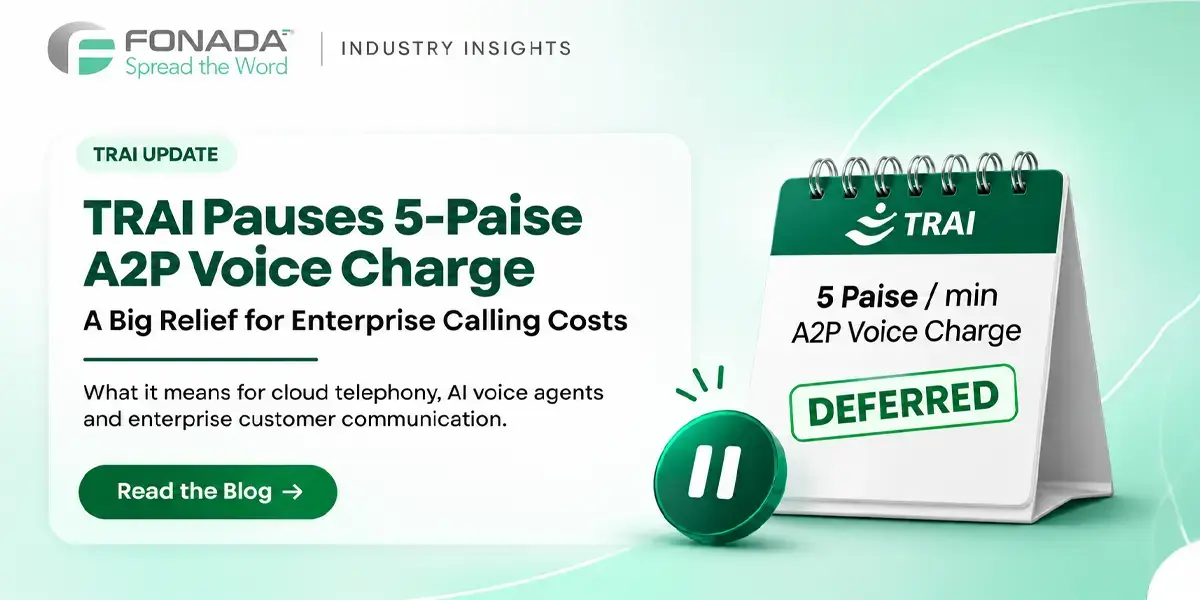
What TRAI's latest decision means for businesses using cloud telephony, AI voice agents, contact centres and automated customer communication.
A Small Charge, A Big Decision for Indian Businesses
Good news for Indian businesses that rely on voice calls to connect with their customers.
The Telecom Regulatory Authority of India (TRAI) has deferred the implementation of the ₹0.05 per minute A2P (Application-to-Person) voice termination charge under Regulation 35A.
The decision, announced through TRAI's Fourth Amendment Regulations dated 4 November 2026, means the charge will not take effect until a new implementation date is officially notified.
For enterprises managing thousands or millions of customer calls every month, this comes as welcome relief.
At Fonada, we believe this is an important development for India's cloud communication industry. It gives businesses breathing room while allowing the telecom ecosystem to address concerns around pricing, billing transparency and the treatment of legitimate business calls.
Because when communication is central to how a business operates, even a five-paise increase deserves serious attention.
Why 5 Paise Can Become a Big Expense
Imagine a bank making thousands of customer verification calls every day.
Or a healthcare provider using automated reminders to reduce missed appointments.
Or an e-commerce company using AI voice agents to confirm orders and manage deliveries.
Each call may last only a few minutes. But multiply those minutes across lakhs of customer interactions, and the numbers start adding up.
The Real Cost of 5 Paise at Enterprise Scale
Here's an illustration of the potential financial impact of a five-paise-per-minute charge.
| Monthly Calling Minutes | Potential Additional Monthly Cost | Annual Impact |
|---|---|---|
| 10 lakh | ₹50,000 | ₹6 lakh |
| 25 lakh | ₹1.25 lakh | ₹15 lakh |
| 50 lakh | ₹2.5 lakh | ₹30 lakh |
| 1 crore | ₹5 lakh | ₹60 lakh |
| 5 crore | ₹25 lakh | ₹3 crore |
Note: These are illustrative calculations assuming all minutes are chargeable at ₹0.05 per minute. Actual applicability depends on the regulatory framework, traffic classification and exemptions. The deferred charge is not currently in effect.
For an enterprise handling one crore billable calling minutes every month, that represents a potential ₹60 lakh in additional annual costs.
And remember, businesses are already investing in telecom connectivity, contact centre infrastructure, customer engagement platforms and AI-powered automation.
Adding another cost layer without clear commercial rules could affect how businesses plan and scale their operations.
The concern is not simply about five paise.
It is about keeping business communication affordable, predictable and commercially sustainable.
Not Every Automated Call Is a Spam Call
India has a genuine problem with unsolicited commercial calls. As an industry, we must support efforts to protect consumers from spam, fraudulent activity and unwanted communication.
But we must also recognise that automated calling is now an essential part of legitimate customer service.
Consider these everyday examples:
-
A banking customer receives a fraud alert or verification call.
-
A patient gets an appointment confirmation from a hospital.
-
An online shopper receives a delivery-related call.
-
A car owner gets a service reminder from an authorised dealership.
-
A website visitor requests an immediate callback from a sales representative.
-
A customer speaks to an AI voice agent before being connected to a human executive.
These calls have a clear business purpose and, depending on the circumstances, may be expected or requested by the customer.
The challenge is that A2P calling is defined by how a call is initiated through an application or automated system, rather than simply whether the recipient wants the call.
That makes accurate classification extremely important.
Businesses adopting AI voice agents and cloud communication should not be treated as irresponsible callers merely because they use automation.
Technology should help distinguish responsible communication from misuse, not create unnecessary barriers for legitimate businesses.
The Larger Issue: Who Ultimately Pays?
Enterprise communication often involves multiple service providers.
A business may work with a cloud communication platform, which in turn relies on underlying telecom network infrastructure.
In regulatory terms, these arrangements can involve Network Service Operators (NSOs), Virtual Network Operators (VNOs), Originating Access Providers and Terminating Access Providers.
For a business customer, however, the expectation is much simpler.
They want reliable calling services at a transparent price.
The concern arises when a network-level charge moves through multiple commercial relationships before reaching the enterprise.
Without clear guidelines, businesses could face unnecessary markups or overlapping charges.
Three issues deserve particular attention.
1. No Duplicate Charging for the Same Communication
A single call should not lead to multiple layers of the same regulatory cost.
If a termination charge is applied at the network level, enterprises need confidence that the same cost is not being charged again unnecessarily through different providers.
Any applicable charge must have a clear regulatory basis and transparent billing treatment.
One call should mean one clearly justified set of charges, not unnecessary duplication.
2. Fair Commercial Treatment for All Service Providers
Cloud communication providers and VNOs play an important role in delivering enterprise services.
They make services such as cloud telephony, programmable voice, AI calling and intelligent contact centres accessible to businesses without requiring them to build their own telecom infrastructure.
Commercial arrangements should encourage competition and innovation rather than create avoidable disadvantages.
If businesses using one type of provider face different cost treatment without a justified reason, it could restrict customer choice.
Fair competition ultimately benefits enterprises through better technology, service quality and pricing.
3. Consistent Treatment of Legitimate Business Calling
Customer-requested calls, service communications and other compliant enterprise interactions need clear regulatory treatment.
TRAI's commercial communication framework includes designated numbering series such as:
-
140 series: Promotional commercial communication.
-
1600 series: Specified service and transactional communication.
-
1601 series: Communication covered by its applicable numbering allocation and usage framework.
The industry needs clarity on how enterprises and communication providers can access and use these resources while meeting applicable DLT and telecom compliance requirements.
Ultimately, businesses should not have to navigate complex inter-operator commercial arrangements simply to understand their monthly communication bills.
What Should Enterprises Do Following TRAI's Decision?
For businesses currently using cloud telephony, IVR, AI voice agents or contact centre solutions, our recommendation is clear.
Do not automatically accept an additional charge described specifically as a Regulation 35A pass-through without checking its regulatory basis.
TRAI has deferred the implementation of this provision. Businesses should therefore question any newly introduced billing component that claims the deferred charge is already applicable.
Here are a few practical steps:
-
Review your current telecom invoices: Look for newly added A2P termination fees or regulatory surcharges.
-
Ask your service provider for clarification: Understand whether a proposed charge is contractual, commercial or regulatory.
-
Avoid unnecessary budget revisions: Do not treat the deferred five-paise charge as an expense already in force.
-
Review your calling infrastructure: Ensure promotional, transactional and service calls follow applicable TRAI requirements.
-
Continue complying with anti-spam rules: The deferment of Regulation 35A does not suspend other calling, declaration, consent or DLT obligations.
This is also a useful time for enterprises to evaluate their overall communication costs.
Are calls being routed efficiently? Are automation workflows reducing unnecessary repeat calls? Is the business getting visibility into calling volumes, connected minutes and customer outcomes?
These questions matter regardless of regulatory changes.
Our View at Fonada: Communication Should Become Smarter, Not More Expensive
India's enterprise communication landscape is changing rapidly.
What once required large calling teams, manual follow-ups and traditional telephony infrastructure can now be managed through intelligent cloud platforms.
AI voice agents are helping businesses respond to enquiries faster, automate routine interactions, support customers across languages and connect conversations with channels such as WhatsApp.
But the true value of these technologies comes when businesses can adopt them confidently.
And confidence requires three things:
Cost transparency. Regulatory certainty. Operational reliability.
At Fonada, these principles guide how we think about enterprise communication.
We believe enterprises should have access to advanced communication technology without unnecessary financial complexity.
We also believe that responsible innovation and consumer protection must go hand in hand.
Protecting customers from unwanted calls is essential. So is enabling banks, hospitals, retailers and service businesses to communicate with customers who genuinely need their assistance.
The right regulatory framework should support both.
As a cloud communication and CPaaS provider, Fonada remains committed to supporting fair industry practices, helping customers understand their communication costs and building solutions that align with India's evolving telecom regulations.
Our focus is not simply on enabling more calls.
It is on making every customer conversation more efficient, meaningful and valuable.
The Road Ahead: A Better Opportunity for India's Telecom Ecosystem
TRAI's decision to defer Regulation 35A is a positive development, but it should be viewed as an opportunity rather than the end of the discussion.
The next phase should bring greater clarity around who pays, what qualifies as chargeable A2P traffic, how compliant enterprise calls are treated and how costs are passed through the telecom ecosystem.
For enterprises, the priority remains unchanged: reliable customer communication at predictable costs.
For the telecom industry, the responsibility is equally clear: encourage innovation, maintain fair competition and protect consumers.
And for regulators, the challenge is to build a framework that supports all three objectives.
India does not need to choose between controlling spam and enabling business innovation. We can, and should, achieve both.
As businesses increasingly depend on AI-powered communication, getting this balance right will become even more important.
At Fonada, we welcome the regulatory breathing room and remain focused on helping Indian enterprises build communication systems that are efficient, compliant and ready for the future.
Because the future of enterprise communication should be about better conversations, not higher costs.
Make Every Business Conversation Count with Fonada
From AI Voice Agents and cloud telephony to IVR, contact centres and omnichannel customer engagement, Fonada helps businesses simplify communication, improve operational efficiency and scale with confidence.
Planning to optimise your enterprise calling costs or modernise your customer communication infrastructure?
Explore our enterprise communication solutions at https://www.fonada.com/ and https://fonada.ai/
Speak with our enterprise solutions team: https://calendly.com/connect-fonada/30min
FAQs
Regulation 35A is a provision under TRAI's Telecom Commercial Communications Customer Preference Regulations. It allows a Terminating Access Provider to charge an Originating Access Provider up to five paise per minute for qualifying Application-to-Person voice calls, subject to specified exemptions. Its implementation has been deferred.
If the charge becomes applicable, it could increase the cost of qualifying high-volume automated calling. For example, one crore chargeable calling minutes at five paise per minute would represent ₹5 lakh per month or ₹60 lakh annually. Actual costs depend on applicability, exemptions and commercial arrangements.
AI voice agents, automated calling systems and cloud communication platforms may initiate calls that meet TRAI's definition of A2P calling. However, not every call is necessarily chargeable. Applicability depends on the regulatory provisions, call classification and relevant exemptions. Regulation 35A's termination charge is currently deferred.
No. TRAI has deferred the implementation of Regulation 35A, which introduced a termination charge of up to ₹0.05 per minute on qualifying A2P voice calls. The charge is on hold until TRAI officially notifies a new implementation date.
Share
.gif "Side Bar Gif")
Subscribe To Our Newsletter
Get updates and learn from the best
Oct 26, 2026
WhatsApp Automation: The Complete Guide to AI Chatbots, Sales & Customer Support in 2026
Customers expect businesses to respond quickly. Whether someone is enq... Read More
Oct 24, 2026
AI Sales Agent for Healthcare: Automate Patient Enquiries & Appointments
AI Sales Agent for Healthcare Healthcare organisations receive enqu... Read More
Oct 22, 2026
AI Sales Assistant for Real Estate: From Leads to Site Visits
Real estate sales move fast. A buyer may fill out a form at 11 pm, call during lunch, or send a What... Read MoreLatest Updates
From Fonada
Industry Insights, Trends, Innovations, Updates, and Case Studies from Industry Experts
View
Customer
Reviews
Discover why our customers love us - read their authentic and heartfelt reviews!
View
Case
Studies
Explore real-life scenarios, offering analysis, and solutions to practical challenges
View
Convert Leads Into Sales With Fonada
Trusted CPaaS Solution Provider