Blog
Round Robin, Sequential, and Parallel Lead Distribution: A Complete Guide for Sales Teams
June 19, 2026
10 min read
Every lead matters.
A potential customer fills out a form, calls your business, responds to an ad, or sends a message on WhatsApp. What happens next often determines whether that lead becomes a customer or disappears forever.
Many businesses spend lakhs of rupees every month on lead generation. They invest in Google Ads, Meta Ads, WhatsApp campaigns, SEO, and outbound calling. Yet, despite generating hundreds or thousands of leads, sales teams still struggle with low conversion rates.
The problem is often not lead generation.
The problem is lead distribution.
If leads are not assigned quickly and fairly, response times increase, sales representatives miss opportunities, and customers choose competitors who respond first.
This is where Lead Distribution becomes critical.
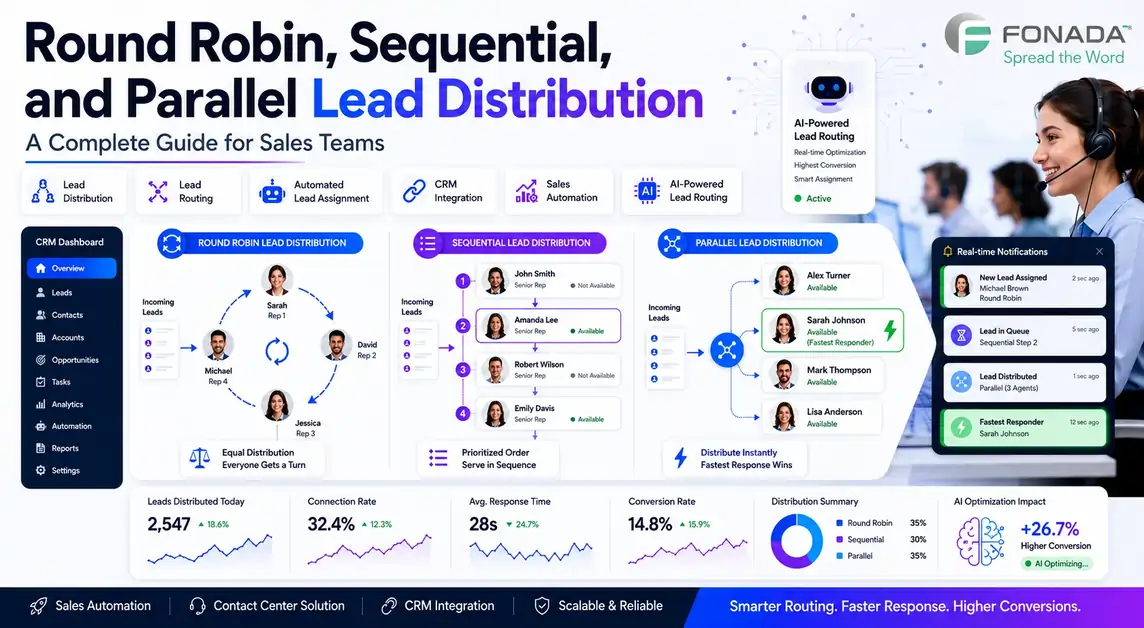
Modern businesses use different lead routing methods such as Round Robin Lead Distribution, Sequential Lead Distribution, and Parallel Lead Distribution to ensure leads reach the right sales representative at the right time.
What Is Lead Distribution?
Lead Distribution is the process of assigning incoming leads to sales representatives, agents, or teams based on predefined rules.
The goal is simple:
- Reduce response time
- Improve lead ownership
- Increase sales productivity
- Improve lead conversion rates
- Ensure fair lead allocation
Without a structured lead routing process, businesses often face challenges such as:
| Challenge | Impact |
|---|---|
| Slow response times | Lower conversions |
| Unassigned leads | Lost opportunities |
| Uneven lead allocation | Poor team morale |
| Manual assignment | Operational inefficiency |
| Delayed follow-up | Reduced customer experience |
A well-designed Lead Management System solves these problems through automated lead routing and intelligent lead assignment rules.
Why Lead Distribution Matters
Research consistently shows that businesses that respond faster to leads achieve higher conversion rates.
When a prospect submits an inquiry, they are actively searching for a solution. If your sales team contacts them within minutes, the chances of conversion increase significantly.
However, if the lead sits unattended for hours, the prospect may already have spoken to a competitor.
Effective lead routing helps businesses:
- Improve first response time
- Increase sales productivity
- Reduce manual work
- Improve contact center operations
- Enhance customer experience
- Increase lead conversion rates
This is why modern organizations invest in Lead Distribution Software and Automated Lead Routing Systems.
What Is Round Robin Lead Distribution?
Round Robin Lead Distribution is one of the most commonly used lead assignment methods.
In this model, incoming leads are distributed equally among available sales representatives in a rotating sequence.
Example
Imagine a sales team with four representatives:
- Agent A
- Agent B
- Agent C
- Agent D
Lead assignments would happen like this:
| Lead | Assigned To |
|---|---|
| Lead 1 | Agent A |
| Lead 2 | Agent B |
| Lead 3 | Agent C |
| Lead 4 | Agent D |
| Lead 5 | Agent A |
| Lead 6 | Agent B |
The cycle continues automatically.
This ensures every representative receives a similar number of leads.
How Round Robin Lead Distribution Works
The process is straightforward:
- A new lead enters the system.
- The lead routing software checks the next available representative.
- The lead is assigned automatically.
- The sequence moves to the next representative.
- The process repeats.
Because the allocation follows a predefined rotation, no manual intervention is required.
This makes round robin one of the most popular methods for inbound lead management.
Benefits of Round Robin Lead Distribution
1. Fair Lead Allocation
Every representative receives an equal opportunity to work on incoming leads.
This eliminates favoritism and creates transparency.
2. Better Team Morale
Sales teams often become frustrated when leads are distributed unevenly.
Round robin creates a balanced environment where everyone receives similar opportunities.
3. Easy to Implement
Most CRM platforms and lead routing systems support round robin distribution.
Implementation is usually simple and fast.
4. Improved Sales Productivity
Managers spend less time assigning leads manually.
Automation allows teams to focus on selling.
5. Faster Response Times
Leads are routed immediately after entering the system.
This helps reduce delays and improve customer engagement.
Limitations of Round Robin Lead Distribution
Although effective, round robin is not perfect.
Skill-Based Matching Is Limited
A lead requiring specialized expertise may be assigned to a representative who lacks experience in that particular industry.
Availability Is Not Always Considered
Traditional round robin systems may continue assigning leads even if a representative is unavailable.
Lead Quality Differences
Not all leads have the same value.
A high-intent enterprise lead and a low-intent inquiry may be distributed equally.
Businesses often solve these challenges using intelligent routing rules combined with round robin distribution.
Best Use Cases for Round Robin Lead Distribution
Round robin works particularly well for:
- SaaS companies
- Real estate teams
- Contact centers
- Insurance sales teams
- Education admissions teams
- E-commerce inquiry management
Organizations with large inbound lead volumes often use round robin to maintain fairness and consistency.
What Is Sequential Lead Distribution?
Sequential Lead Distribution follows a priority-based approach.
Instead of distributing leads equally, the system attempts to assign a lead to the first representative in a predefined order.
If that representative does not respond or is unavailable, the lead moves to the next person in the sequence.
This process continues until someone accepts or responds to the lead.
How Sequential Lead Distribution Works
Consider the following sequence:
- Agent A
- Agent B
- Agent C
- Agent D
When a lead arrives:
- The system first assigns it to Agent A.
- If Agent A does not respond within a defined period, it moves to Agent B.
- If Agent B is unavailable, it moves to Agent C.
- The process continues until the lead is handled.
This method prioritizes response rather than equal distribution.
Benefits of Sequential Lead Distribution
1. Faster Lead Ownership
The lead is always moving toward someone who can take action.
This reduces the risk of leads remaining unattended.
2. Better Accountability
Representatives know they are first in line.
This encourages quicker responses.
3. Ideal for High-Value Leads
Businesses often use sequential routing for premium inquiries where response quality is more important than equal allocation.
4. Improved Lead Qualification
Leads can be assigned according to expertise levels.
For example, senior sales executives can receive priority access to enterprise opportunities.
Limitations of Sequential Lead Distribution
Uneven Lead Allocation
The first representatives in the sequence may receive significantly more opportunities.
Potential Agent Burnout
If lead volume is high, top-priority representatives can become overloaded.
Requires Monitoring
Managers need to review routing rules regularly to maintain efficiency.
Best Use Cases for Sequential Lead Distribution
Sequential routing works best when businesses prioritize expertise or response quality.
Examples include:
- Enterprise software sales
- Financial services
- Healthcare consultation teams
- Premium real estate projects
- High-ticket B2B sales
These industries often value expertise over equal distribution.
Round Robin vs Sequential Lead Distribution
The biggest difference lies in how leads are assigned.
| Feature | Round Robin | Sequential |
|---|---|---|
| Distribution Style | Equal rotation | Priority order |
| Fairness | High | Medium |
| Response Focus | Moderate | High |
| Skill-Based Routing | Limited | Strong |
| Lead Ownership | Shared | Prioritized |
| Best For | Large teams | High-value leads |
If fairness is your priority, round robin is often the better choice.
If expertise and response quality matter more, sequential routing may deliver stronger results.
What Is Parallel Lead Distribution?
Parallel Lead Distribution is a more advanced lead routing strategy.
Instead of assigning a lead to one representative at a time, the system alerts multiple representatives simultaneously.
The first representative who responds receives ownership of the lead.
This approach is commonly used in high-speed sales environments where response time directly impacts revenue.
How Parallel Lead Distribution Works
Imagine a new lead enters your CRM.
Instead of sending it to a single representative, the system instantly notifies:
- Agent A
- Agent B
- Agent C
- Agent D
Whoever responds first gets the lead.
The remaining notifications automatically expire.
This creates a competitive environment focused on speed.
Parallel Lead Distribution Benefits
1. Extremely Fast Response Time
The biggest advantage of parallel lead distribution is speed.
Multiple representatives receive the lead at the same time. The first person to respond takes ownership.
This significantly reduces first response time, which is one of the strongest factors affecting lead conversion rates.
2. Higher Lead Conversion Rates
When prospects receive immediate attention, they are more likely to engage.
This is especially important for industries where customers contact multiple vendors before making a decision.
3. Better Customer Experience
Customers appreciate quick responses.
Instead of waiting for a representative to become available, they connect with the first available agent.
4. Improved Agent Availability Utilization
Parallel routing ensures leads are handled by available representatives rather than waiting in a queue.
5. Ideal for Contact Center Operations
Many contact centers and inside sales teams use parallel routing to maximize efficiency and reduce missed opportunities.
Limitations of Parallel Lead Distribution
Can Create Competition Among Representatives
If not managed correctly, representatives may focus only on speed rather than quality conversations.
Duplicate Outreach Risk
Poorly configured systems may allow multiple agents to contact the same lead.
A reliable lead routing system prevents this issue by automatically locking lead ownership.
Not Suitable for Every Business
Businesses handling highly specialized inquiries may prefer sequential routing to ensure the lead reaches the most qualified representative.
Sequential vs Parallel Lead Distribution
| Feature | Sequential Distribution | Parallel Distribution |
|---|---|---|
| Assignment Style | One-by-one priority order | Multiple agents at once |
| Response Speed | Fast | Very Fast |
| Lead Ownership | Assigned sequentially | First responder wins |
| Agent Competition | Low | High |
| Customer Wait Time | Moderate | Lowest |
| Best For | Enterprise sales | Contact centers |
Which Lead Distribution Method Is Best?
There is no single answer because every business operates differently.
The best lead distribution strategy depends on:
- Lead volume
- Team size
- Industry
- Sales cycle
- Agent expertise
- Response time goals
Choose Round Robin If:
- You want fair lead allocation.
- Your team members have similar skills.
- You receive a large number of inbound leads.
- You want balanced lead ownership.
Choose Sequential If:
- Certain representatives have specialized expertise.
- You handle high-value leads.
- Response quality is more important than equal distribution.
- You want priority-based lead assignment.
Choose Parallel If:
- Speed is your top priority.
- You run a contact center.
- You handle time-sensitive inquiries.
- You want the fastest possible first response time.
Many modern organizations combine all three approaches using intelligent routing rules.
Lead Distribution Strategies for Different Industries in India
Use Case 1: Real Estate Lead Distribution
The Indian real estate market is highly competitive.
When a prospect submits an inquiry for a property, multiple developers and brokers may contact them within minutes.
A delayed response often means losing the opportunity.
A real estate company can use:
- Round robin for general inquiries
- Sequential routing for premium projects
- Parallel routing for urgent site visit requests
Businesses looking to improve lead capture can also explore WhatsApp automation. Related reading: WhatsApp Automation for Real Estate Lead Generation
Use Case 2: Healthcare Lead Management
Hospitals, clinics, and diagnostic centers receive inquiries for appointments, consultations, and follow-ups.
Response delays can impact patient experience.
Healthcare organizations often use:
- Sequential lead routing for specialist consultations
- Parallel routing for emergency callback requests
- Automated lead routing for appointment scheduling
Learn more about patient communication strategies in Healthcare Patient Engagement with SMS and IVR
Use Case 3: Contact Centers and BPOs
Contact centers manage thousands of calls and leads every day.
Manual lead assignment is simply not practical.
These businesses rely on:
- Automated lead routing
- Call routing
- Agent availability tracking
- Parallel lead distribution
Combined with predictive dialing, businesses can significantly improve productivity.
What Is Automated Lead Routing?
Automated Lead Routing is the process of assigning leads automatically based on predefined rules.
Instead of manually allocating leads, the system evaluates factors such as:
- Agent availability
- Skill level
- Geography
- Language preference
- Lead source
- Product interest
- Previous interactions
The lead is then assigned instantly.
This improves efficiency while reducing operational workload.
Benefits of Automated Lead Routing
Faster Lead Response
Leads reach the right representative immediately.
Improved Sales Productivity
Representatives spend more time selling and less time managing assignments.
Better Lead Ownership
Every lead has a clearly assigned owner.
Reduced Human Error
Manual allocation mistakes are eliminated.
Improved Conversion Rates
Faster engagement often results in more conversions.
Lead Routing Best Practices
Define Clear Lead Assignment Rules
Create routing rules based on business goals rather than convenience.
Track First Response Time
Measure how quickly representatives contact new leads.
Use CRM Integration
Integrating lead routing with your CRM ensures seamless lead management.
Monitor Agent Availability
Avoid assigning leads to unavailable representatives.
Review Performance Regularly
Analyze conversion rates and adjust routing rules accordingly.
Automate Wherever Possible
Manual processes slow down growth.
Automation ensures consistency and scalability.
How Lead Routing Improves Conversions
Lead routing impacts nearly every stage of the sales process.
When the right representative contacts the right prospect at the right time:
- Response time decreases
- Customer experience improves
- Lead qualification becomes easier
- Sales productivity increases
- Lead conversion rates improve
Businesses that optimize inbound lead management often see measurable improvements in revenue performance.
Lead Distribution Software: What Features Should You Look For?
When evaluating Lead Distribution Software, consider the following capabilities:
| Feature | Why It Matters |
|---|---|
| Automated Lead Assignment | Eliminates manual work |
| CRM Integration | Centralized lead management |
| Round Robin Routing | Fair distribution |
| Sequential Routing | Priority-based assignment |
| Parallel Routing | Fast response times |
| Call Routing | Improved call center operations |
| Analytics Dashboard | Performance tracking |
| Agent Availability Management | Better lead allocation |
| Multi-Channel Support | Handles calls, WhatsApp, SMS, and web leads |
How Fonada Helps Businesses Automate Lead Distribution
As businesses grow, manual lead assignment becomes difficult to manage.
This is where Fonada helps.
Through intelligent lead distribution automation, businesses can:
- Route leads automatically
- Improve first response time
- Optimize call routing
- Increase agent productivity
- Improve lead conversion rates
- Streamline inbound lead management
Fonada's communication and sales automation ecosystem enables businesses to manage leads efficiently across calls, WhatsApp, SMS, and digital channels.
Organizations looking to modernize customer communication can explore:
Fonadial Auto Dialer and Lead Distribution Automation
Businesses handling large lead volumes often combine lead routing with auto dialing.
The combination allows sales teams to:
- Assign leads automatically
- Initiate outbound calls faster
- Reduce idle agent time
- Increase contact rates
- Improve sales efficiency
Fonadial Auto Dialer Features
- Predictive Dialer capabilities
- Automated Lead Assignment
- Contact Center Solution
- AI-Powered Lead Routing
- Call Routing Solution
- Sales Automation Platform
- Lead Distribution Automation
Learn more:
- Fonadial Auto Dialer Software
- Click to Call Solution
- Number Masking Solution
- Virtual Number Solution
- Call Center IVR Solution
Additional Resources
You may also find these resources helpful:
- Bulk WhatsApp Messages Guide 2026
- How to Make a WhatsApp Bot
- AI Call Center Voice Bots Replacing Traditional Call Centers
- How to Stop Losing Leads After Business Hours with Fonada AI
- AI Voice Bots for Real Estate Lead Generation
- How One AI Voice Bot Dialled 25 Lakh Calls in a Single Day
Explore more solutions on the Fonada website here: 👉 Fonada
Get in touch with us:
👉 Contact us: https://bit.ly/47OjrVH
👉 WhatsApp: https://wa.me/7479574795?text=
👉 Subscribe on LinkedIn: https://bit.ly/4pPuQL8
👉 Subscribe A DEMO: https://calendly.com/connect-fonada/30min
FAQs
Sequential Lead Routing assigns leads according to a predefined priority order. If the first representative does not respond, the lead moves to the next representative.
Parallel Lead Distribution sends lead notifications to multiple representatives simultaneously. The first representative who responds receives ownership of the lead.
The best method depends on business goals. Round robin is ideal for fairness, sequential routing is useful for expertise-based assignments, and parallel routing is best when response speed is critical.
Sales teams use Lead Distribution Software, CRM Lead Assignment tools, and Automated Lead Routing systems to allocate leads based on predefined rules.
Automated Lead Routing automatically assigns leads based on criteria such as availability, expertise, location, language, and lead source.
Round robin distributes leads equally among representatives, while sequential routing assigns leads according to a predefined priority order.
Sequential routing assigns leads to one representative at a time. Parallel routing alerts multiple representatives simultaneously.
Round Robin Lead Distribution assigns leads equally among sales representatives in a rotating sequence. It ensures fair lead allocation and balanced workload distribution.
Share
.gif "Side Bar Gif")
Subscribe To Our Newsletter
Get updates and learn from the best

Sep 01, 2026
AI Sales Agent for Education: Convert More Enquiries
It is admission season. Your phone will not stop ringing. Your WhatsApp Business number has forty un... Read More
Aug 12, 2026
From Lead to Closing: How AI Sales Assistants Help Real Estate Agents Sell More
Real estate sales move fast. A buyer may fill out a form at 11 pm, cal... Read More
Aug 10, 2026
AI Sales Agent for Healthcare
AI Sales Agent for Healthcare Healthcare organisations receive enquiries every day through websit... Read MoreLatest Updates
From Fonada
Industry Insights, Trends, Innovations, Updates, and Case Studies from Industry Experts
View
Customer
Reviews
Discover why our customers love us - read their authentic and heartfelt reviews!
View
Case
Studies
Explore real-life scenarios, offering analysis, and solutions to practical challenges
View
Convert Leads Into Sales With Fonada
Trusted CPaaS Solution Provider