Blog
AI Sales Assistant for Car Dealerships: How AI Can Turn More Enquiries into Test Drives and Sales
September 2, 2026
9 min read
Buying a car in India rarely starts at the showroom today. A customer may discover a model on Instagram, compare variants on Google, watch reviews on YouTube, calculate EMI options, send a WhatsApp enquiry, and contact several dealerships before deciding where to take a test drive. By then, the buyer may already know the features, expected price range, competing models, and finance choices.
For dealerships, this creates a costly gap. Leads arrive from more channels and at more hours, while customers expect quick answers. Human teams still need to qualify intent, answer repeated questions, schedule test drives, follow up, update the CRM, and give serious buyers personal attention.
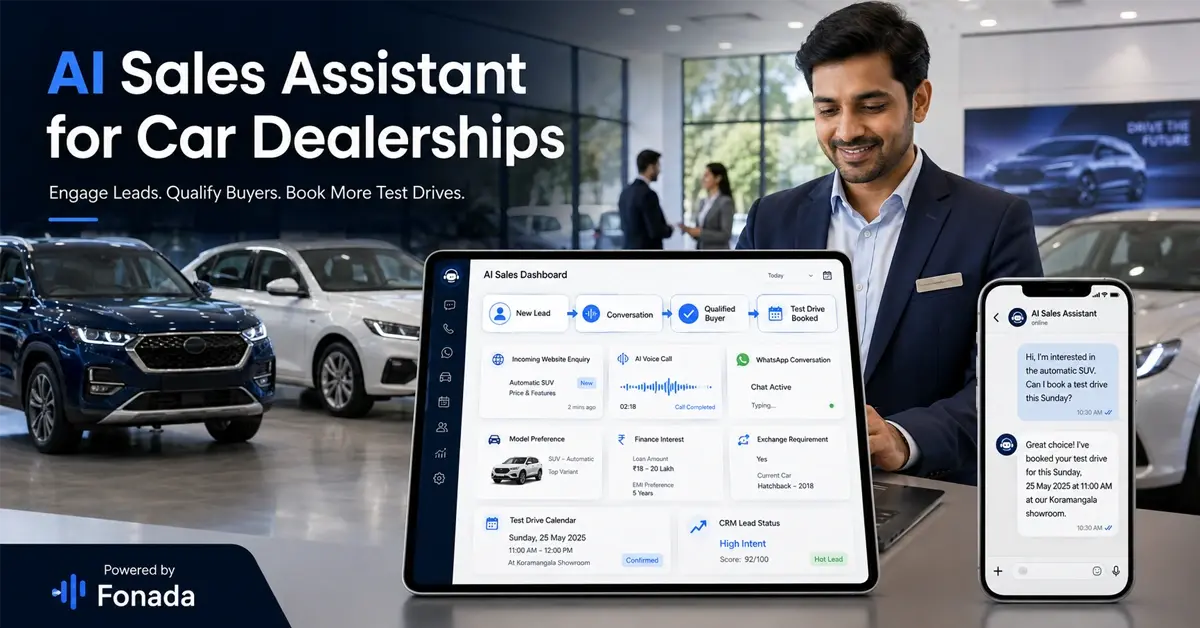
An AI Sales Assistant for Car Dealerships can respond to leads, ask qualification questions, share approved information, book test drives, send reminders, update records, and hand high-intent buyers to the right salesperson.
The goal is not to remove people from automobile sales. Cars remain high-consideration purchases where buyers value trust, advice, negotiation, finance support, exchange evaluation, and the showroom experience. AI works best when it handles repetitive work around those human moments.
What Is an AI Sales Assistant for Car Dealerships?
An AI Sales Assistant for Car Dealerships is conversational software designed to support dealership sales workflows across AI voice calls, WhatsApp, web chat, SMS, RCS, or other connected channels.
Unlike a basic scripted chatbot, a modern automotive AI assistant can understand natural questions, capture details, follow dealership rules, and take approved actions.
Suppose a customer enquires about an SUV at 9:45 pm. An AI Sales Agent for Car Dealerships can acknowledge the enquiry, ask which variant the buyer wants, check the buying timeline, capture finance or exchange interest, and offer a test-drive slot. The sales team receives context instead of starting with a cold lead the next morning.
That is practical automotive sales automation.
For a broader foundation, read Fonada's complete guide to AI sales agents and its guide on how an AI Sales Assistant can qualify leads, book meetings and support closing.
Why Car Dealership Sales Needs Faster Lead Engagement
A digital enquiry rarely belongs to one dealership for long. Buyers comparing a hatchback, SUV, EV, or premium vehicle can contact sellers within minutes.
McKinsey reported in 2025 that more than half of new automotive leads in the dataset it referenced arrived after hours. The research was US focused, but the lesson is relevant: delay can weaken engagement while buying intent is active.
KPMG's India CX Report 2025 found that 50 percent of passenger-vehicle customers considered pre-purchase assessment the most impactful stage in overall brand perception.
An AI for Car Dealerships strategy should therefore reduce waiting, provide information quickly, and make the next step easy.
Where Dealership Lead Leakage Happens
Most dealerships do not intentionally ignore buyers. Leakage happens because digital lead generation for car dealerships moves faster than manual follow-up.
A Meta lead arrives while executives serve showroom visitors. A marketplace enquiry enters the CRM at 11 pm. A launch campaign suddenly creates hundreds of car dealership leads. A salesperson forgets follow-ups. Another conversation happens, but notes never reach the car dealership CRM.
These gaps weaken car dealership lead generation and automotive lead generation because marketing spend creates enquiries that the sales process does not consistently work.
An AI Agent for Car Dealerships can provide a first response, collect information, classify intent, and prepare the next action while human executives focus on serious automotive sales leads.
That is the strongest case for car dealership sales automation: stopping routine gaps from wasting enquiries.
Fonada discusses the problem in its guide on how to stop losing leads after business hours with AI.
How an Automotive AI Agent Works
A useful AI setup should follow the dealership's existing sales process.
First, a lead enters from a website, ad campaign, inbound call, WhatsApp, automotive marketplace, OEM system, or another approved source.
Second, the automotive AI agent begins the right interaction, such as an AI calling agent for car dealerships, WhatsApp conversation, or web assistant.
Third, it asks qualification questions about model, variant, budget, city, buying timeline, finance, exchange, and preferred showroom.
Fourth, it records the answers and selects the next approved action. A buyer planning to purchase this week should be treated differently from someone researching a future upgrade.
Fifth, the assistant can offer a test drive, send confirmation, and update the automotive CRM or dealership lead management system when integrations are available.
Finally, a human salesperson receives context rather than only a name and mobile number.
The best workflow feels like an organised dealership that remembers what the customer already said.
AI Voice Agent for Car Dealerships
Voice remains valuable in Indian automobile sales because many buyers prefer explaining requirements rather than typing them.
An AI Voice Agent for Car Dealerships can make or receive approved calls, ask structured questions, capture responses, and move a conversation towards a clear next step.
For example, a compact SUV buyer can be asked about transmission preference, budget, exchange requirement, finance interest, purchase timeline, and test-drive availability. Multilingual support can also help dealership groups serving customers across different states, provided the deployed model supports those languages accurately.
Fonada's public communication stack includes voice, AI-enabled customer engagement, WhatsApp Business API, RCS, SMS, IVR, and CRM or enterprise integrations. For more context, see its guide to AI voice bots and modern call centres and its example of an AI voice bot operating at large calling scale.
WhatsApp for Automobile Dealership Follow-Up
A car purchase creates many small questions. Is this colour available? What is the waiting period? Can I get the brochure? Is there an automatic variant? What documents are needed for finance? Can I visit on Sunday?
Customers do not always want a phone call for every answer.
WhatsApp can complement an AI Sales Assistant for Car Dealerships by continuing approved conversations, sharing information, confirming appointments, sending reminders, and keeping warm leads active between calls.
Fonada's WhatsApp Business guide for the automobile industry covers automotive use cases in more detail. Teams can also review how to make a WhatsApp bot and the bulk WhatsApp messaging guide for campaign context.
A good system should respect customer consent, communication preferences, approved templates, and applicable rules. Automation should make communication more useful, not more intrusive.
What Can AI for Auto Dealers Handle?
The most useful workflows are repetitive, time-sensitive, and measurable.
| Dealership activity | Common manual problem | AI-supported workflow |
|---|---|---|
| New lead response | Enquiries wait when staff are busy | Immediate acknowledgement and qualification |
| Test-drive booking | Repeated calls and coordination | Offer slots, confirm, and remind |
| Lead qualification | Repeated questions | Capture model, budget, timeline, and intent |
| Follow-up | Warm leads are forgotten | Rules-based follow-up |
| Incoming calls | Busy lines and missed calls | Answer common queries and route |
| CRM updates | Notes are incomplete | Record structured outcomes |
| Launch campaigns | Sudden lead spikes | Scale first-line engagement |
| Old lead reactivation | Databases stay untouched | Re-engage selected segments |
This also explains why automotive lead management software alone may not solve the problem. A CRM stores information. An AI layer can help create, organise, and act on that information through conversations.
India Use Case 1: Test-Drive Conversion in Delhi NCR
Imagine a multi-brand dealer group in Delhi NCR receiving 1,200 digital enquiries during a festive campaign from Meta ads, Google, the dealer website, automotive portals, and calls.
The same pressure appears in online lead generation for car dealers and car showroom lead generation. For teams asking how to increase car dealership sales, the answer often begins with better response and follow-up rather than simply buying more leads.
The traditional approach distributes leads across sales executives. Response slows during busy showroom hours, while enquiries after closing wait until morning.
With an AI Sales Assistant for Car Dealerships, each eligible lead can receive an immediate first response. The assistant can confirm model, purchase timeline, location, finance interest, and exchange requirement. High-intent buyers can be offered a test drive or passed to a human.
A customer looking for an SUV under ₹20 lakh and planning to buy this week deserves different priority from someone casually researching a future purchase. AI helps identify that difference earlier.
The next morning, salespeople can begin with qualified conversations and appointments instead of dialling the whole list.
Useful KPIs include response time, contact rate, qualified-lead rate, test drives booked and completed, showroom visits, lead-to-sale conversion, and cost per retail sale.
India Use Case 2: Multilingual Follow-Up Across South India
Consider a dealer network across Karnataka, Tamil Nadu, Telangana, and Andhra Pradesh. Campaigns generate enquiries in many cities, but the central team has uneven language coverage.
A customer may browse in English but prefer discussing family needs, finance, exchange value, or delivery timing in a local language.
A multilingual AI for Automobile Dealerships setup can provide initial engagement in supported languages, capture intent, and route the prospect to the right showroom or salesperson.
The value is continuity, not just translation. When the customer reaches a human executive, the lead record can already show model, language, location, timeline, and questions raised.
Deloitte's 2026 India automotive study found strong consumer interest in AI-enabled vehicle customisation, while KPMG has highlighted personalised digital interactions and seamless online-to-offline journeys as important directions for automotive customer experience.
Used carefully, an automotive AI assistant can support that expectation before the customer enters the showroom.
AI Should Support Salespeople, Not Pretend to Replace Them
Real dealership discussions online offer an important warning.
On Reddit's car-sales communities, some dealership employees describe AI follow-up as useful for late-night engagement and repetitive outreach. Others dislike poorly implemented systems, especially when customers are confused about whether they are speaking with a real person.
The assistant's role should therefore be clear. It should not invent facts, promise unapproved discounts, hide uncertainty, or continue when human judgement is required. Negotiations, complaints, unusual finance questions, and high-intent closing conversations need easy human handoff.
Automotive AI video descriptions reviewed for this topic focus on lead coverage, faster replies, follow-up sequences, multilingual voice, inventory context, and appointment booking. A 2026 dealership-industry video discussion also stressed that effective AI needs training and tuning to reflect dealership processes and communication style.
The lesson is simple: speed without trust is not enough.
AI Sales Assistant vs Traditional Dealership Lead Management
| Area | Traditional process | AI-supported process |
|---|---|---|
| Availability | Mainly business hours | 24/7 first-line response |
| First contact | Depends on workload | Triggered automatically |
| Qualification | Manual and variable | Standardised questions |
| Follow-up | Task and memory dependent | Rules-based sequences |
| Language | Limited by staff availability | Multiple supported languages |
| Handoff | Often limited context | Captured summary and fields |
| Campaign scale | More people needed | Higher simultaneous capacity |
| Human focus | Prospecting, admin, and closing | More advice and closing |
The practical model is hybrid. AI handles speed, repetition, data capture, and routine coordination. Humans handle judgement, emotion, negotiation, product expertise, and relationship building.
Where Fonada Fits
Fonada provides cloud communication and customer-engagement capabilities across voice and digital channels. Its public platform includes cloud telephony, AI-powered voice bots and chatbots, WhatsApp Business API, RCS, SMS, IVR, cloud contact centre tools, and CRM or enterprise integrations.
For dealerships, this can connect lead qualification, reminders, messaging, and human escalation instead of creating separate workflows.
Explore Fonada or request a demo. Call-heavy teams can also review Fonada auto dial software, call centre IVR, and IVR software for startups and SMEs.
How to Implement AI for Car Dealerships
Start with one measurable problem, such as slow first response, low test-drive booking, missed calls, inconsistent follow-up, poor CRM notes, or inactive leads.
Map where leads enter, who owns them, which questions are asked, what information may be shared, when a human must take over, and how outcomes are recorded.
Give the AI Sales Agent for Car Dealerships one narrow first job. New-lead qualification plus test-drive scheduling is a sensible starting point because it is clear and measurable.
Integrate with the dealership lead management system or automotive CRM where practical. Without integration, the dealership may simply create another inbox.
Create guardrails for price, offers, inventory, waiting periods, finance claims, customer data, language, consent, and escalation.
Run a pilot and compare response time, contact rate, appointment rate, show rate, qualified opportunities, conversion, and staff time against a baseline. Expand only after the workflow proves useful.
Automotive CRM Plus AI
A car dealership CRM is the memory of the sales operation, while AI can become an active interface for car dealership lead management.
A conversation might become structured data: seven-seat SUV, ₹25 lakh budget, four-week timeline, sedan exchange, finance required, Saturday test drive. That is more useful than a generic “Call lead” task.
Modern CRM for car dealerships increasingly connects conversation summaries, next actions, and omnichannel journeys. The same direction is visible in automotive CRM software and broader automobile lead management software.
McKinsey argues that dealership productivity depends less on isolated point solutions and more on deeper integration across sales processes.
The principle applies in India too. Better automotive lead management comes from connected workflows, not simply buying more software.
The Customer Relationship Continues After Delivery
Dealership communication continues after delivery through service reminders, insurance renewal, accessories, extended warranty, feedback, exchange opportunities, and future upgrades.
The same communication infrastructure used for sales can support post-sale engagement with suitable permissions. Fonada's resources on customer service software, RCS backed by SMS, and business communication offer useful background.
The exact journey differs by OEM, dealer group, DMS, CRM, and regulatory requirements. What matters is continuity. Customers should not need to restart the relationship every time they change channels or move from sales to service.
Useful Automation Lessons from Other Industries
High-volume sectors face similar response problems. Relevant Fonada reading includes real estate WhatsApp automation, real estate AI voice bots, e-commerce WhatsApp chatbots, banking chatbots, retail chatbots, high-volume e-commerce support, and healthcare engagement.
The shared lesson is simple: remove repetitive friction before customer interest disappears.
How to Measure Automotive Sales Automation
Do not judge an AI Calling Agent for Car Dealerships only by how natural the voice sounds.
Track first-response time, contact rate, qualified opportunities, test-drive bookings, completed test drives, showroom visits, lead-to-sale conversion, follow-up completion, staff time saved, complaints, and opt-outs. Compare results by source, campaign, model, location, language, and time of day.
A pilot needs a baseline so the dealership can separate AI impact from campaign changes.
Fonada has discussed sales outcomes in its article on boosting sales with an AI voice bot. Any performance claim should still be tested against the dealership's own data.
What Dealerships Should Avoid
Do not automate inaccurate inventory, price, waiting period, finance, or exchange information. Do not let AI negotiate outside approved rules. Do not send endless follow-ups because automation is cheap. Do not hide human escalation or launch without reviewing real conversations.
Customers also prefer different channels. Some want a quick call, some want WhatsApp, and others want a showroom conversation.
A strong AI for Auto Dealers strategy gives each customer faster access to the right next step.
Why This Matters in 2026
Automotive retail is becoming a blended journey across digital research, AI discovery, messaging, voice, showrooms, finance, and ownership services.
BCG's 2025 research identified marketing and sales as a major near-term opportunity for automotive AI. McKinsey's 2026 mobility research described vehicle buying as increasingly omnichannel and AI-enabled. KPMG's 2026 India automotive retail forum also focused on AI-powered engagement and dealer productivity.
Every dealership does not need to automate everything. But the standard for responsiveness is rising, and late replies increasingly feel like a process limitation to customers.
A practical dealership pilot should also include human review. Listen to sample calls, read message transcripts, check whether the assistant captures the correct model and variant, and test difficult questions before increasing volume. Ask sales executives whether the summaries are genuinely useful when they call the customer. Ask managers whether appointments are reaching the correct showroom. Review cases where the AI should have escalated sooner. This operating discipline matters because customer experience depends not only on the AI model, but also on dealership data, workflows, training, integrations, supervision, and continuous improvement.
Final Takeaway
The best dealership salesperson should spend time understanding buyers, demonstrating cars, building confidence, negotiating fairly, and closing business. They should not spend their best hours repeating the same qualification questions or manually chasing overnight enquiries.
That is where an AI Sales Assistant for Car Dealerships becomes practical.
It helps dealerships respond faster, qualify consistently, coordinate test drives, maintain follow-up, and give human salespeople better context. Combined with a connected car dealership CRM, clear guardrails, and easy human handoff, AI can turn automotive sales automation from an experiment into a measurable sales process.
For Indian dealer groups, the opportunity is simple: protect the leads you already pay to generate before spending more money generating new ones.
If your dealership is evaluating AI for lead qualification, voice calls, WhatsApp engagement, test-drive booking, or connected customer communication, explore Fonada and request a demo using your real dealership workflow.
FAQs
Yes. With scheduling integration, an AI Sales Agent for Car Dealerships can collect timing preferences, offer slots, confirm bookings, and send reminders.
Yes, where the workflow follows applicable consent, telecom, privacy, and communication requirements.
No. An automotive AI agent handles repetitive engagement while humans focus on advice, test drives, finance, negotiation, trust, and closing.
Yes, if systems support integration. AI can send qualification details, appointments, summaries, and outcomes into an automotive CRM or dealership lead management system.
New lead qualification and test-drive booking are practical because they are high-volume and measurable.
Fonada provides telephony, voice, WhatsApp, RCS, SMS, IVR, AI-powered voice bots, chatbots, and integration options for dealership workflows.
An AI Sales Assistant for Car Dealerships responds to enquiries, qualifies prospects, books test drives, follows up, updates records, and hands suitable opportunities to human salespeople.
Share
.gif "Side Bar Gif")
Subscribe To Our Newsletter
Get updates and learn from the best
Sep 28, 2026
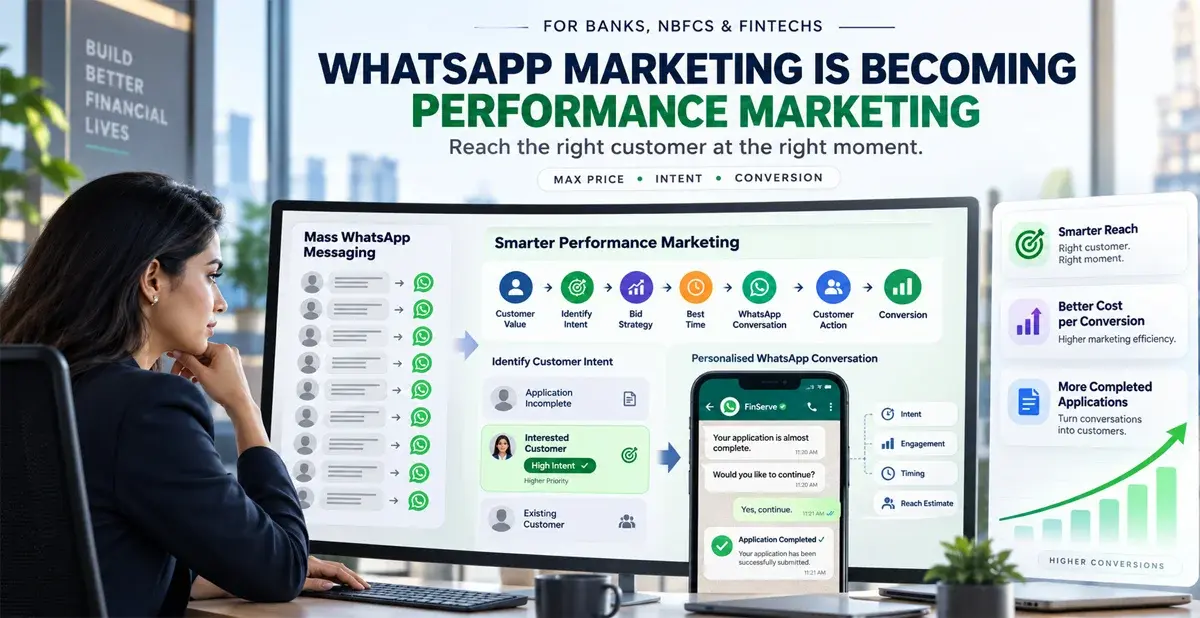
WhatsApp Marketing Bidding for Fintech in India: Meta Max Price, Timing & Delivery Guide (2026)
Meta is moving WhatsApp marketing beyond a fixed-price messaging model... Read More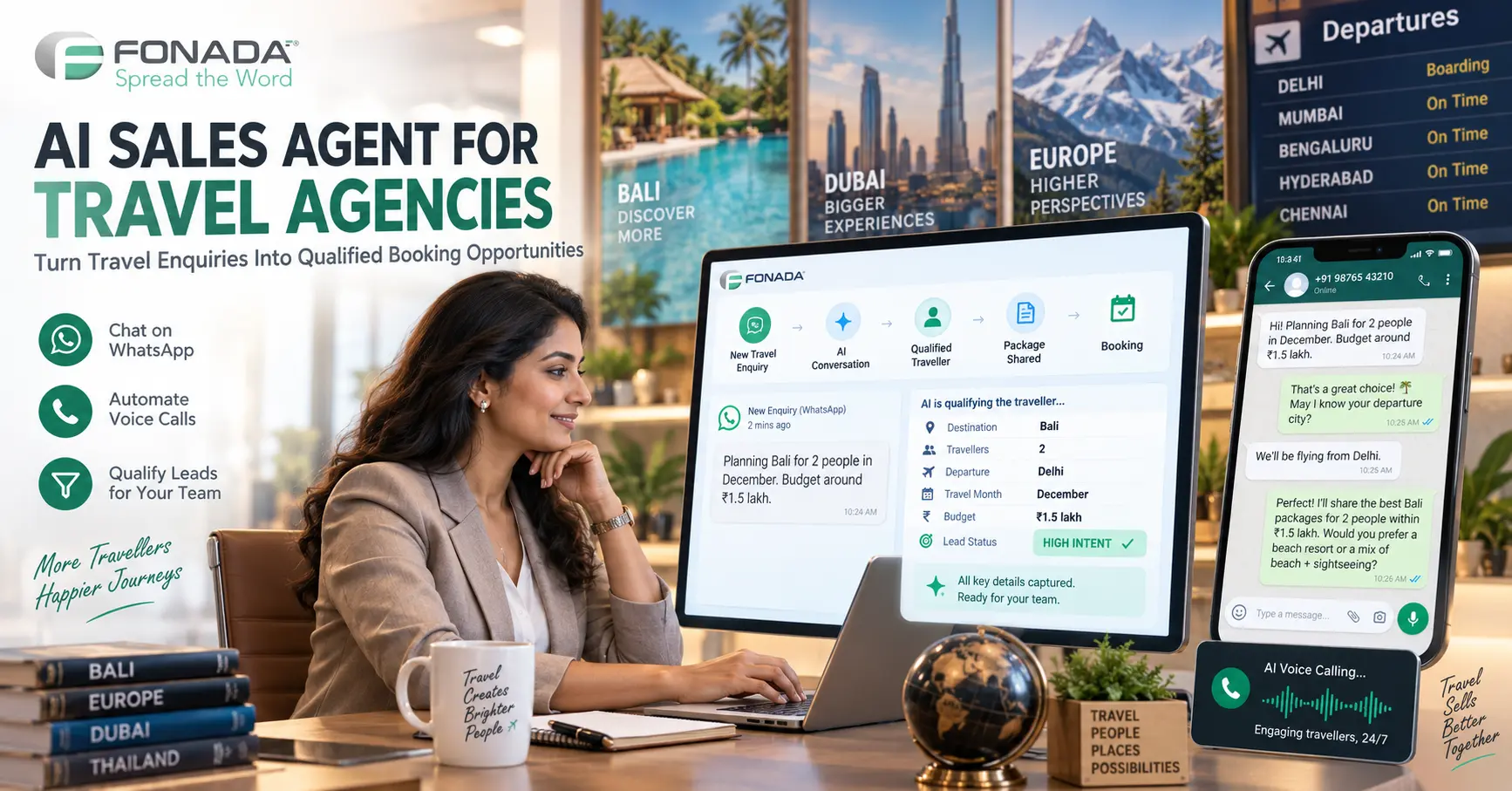
Sep 22, 2026
AI Sales Agent for Travel Agencies: Convert More Travel Leads
Travel enquiries rarely arrive at a convenient time. A family may ask for a Kerala package at 10:30... Read More
Sep 18, 2026
AI Sales Assistant for Logistics and Transportation
India’s logistics and transportation sector moves fast, but the sales process often does not.... Read MoreLatest Updates
From Fonada
Industry Insights, Trends, Innovations, Updates, and Case Studies from Industry Experts
View
Customer
Reviews
Discover why our customers love us - read their authentic and heartfelt reviews!
View
Case
Studies
Explore real-life scenarios, offering analysis, and solutions to practical challenges
View
Convert Leads Into Sales With Fonada
Trusted CPaaS Solution Provider